

Last Updated: October 30, 2026
Quick Summary
You can check diamond clarity at home with a 10x jeweler's loupe, bright white light and a clean stone, looking for cracks, chips and clouds. A home check shows whether a stone looks clean or heavily included, but it cannot assign an official clarity grade. Only a written professional grading report can do that.
- Use a 10x jeweler's loupe, the standard magnification for stone inspection.
- Clean the stone first, since dirt and oil can hide inclusions.
- Place the stone crown side up under bright white light on a dark surface.
- Check the table, crown, girdle and pavilion for cracks and chips.
- A home check cannot replace a professional grading report.
Table of Contents
- What You Can and Cannot Judge About Diamond Clarity at Home
- What You Need: A Loupe, Good Light and a Clean Stone
- How to Clean a Diamond Before Inspection
- Step-by-Step: How to Inspect a Diamond with a Loupe
- Diamond Inclusions Visible to the Naked Eye
- Why Professional Diamond Clarity Grading Still Matters
- Booking Your Diamond Inspection at Eklektic in Houston
- Frequently Asked Questions
What You Can and Cannot Judge About Diamond Clarity at Home
Checking diamond clarity at home has real limits, and it helps to know them before you start. A loupe or microscope lets you look closely at a stone's inclusions and blemishes. What it cannot do reliably is produce an official clarity grade. That grade comes from a trained grader working under controlled conditions.
Clarity describes how many internal inclusions and external blemishes a diamond has, and how visible they are under magnification (Diamond Clarity). Professionals commonly use the GIA grading system, which describes diamonds through four factors: cut, color, clarity and carat weight (GIA Diamond Grading Scales: Universal Quality Measure).
Here is what a home check can do:
- Show you whether a stone looks clean or heavily included under magnification
- Help you spot obvious chips, cracks or a loose setting
- Give you a sense of what to ask a professional about
Here is what it cannot do:
- Assign an official clarity grade
- Confirm a stone is the quality a seller claims
- Replace a written grading report
Watch out: Do not treat a home check as proof of a stone's grade.
What You Need: A Loupe, Good Light and a Clean Stone
You do not need expensive equipment for a basic look at a stone. You do need the right tools, used the right way.
Gather these items before you begin:
- A 10x jeweler's loupe: This is the standard magnification for stone inspection. Look for one with a clean, flat lens.
- Bright, white light: A desk lamp with a daylight bulb works well. Avoid dim or yellow light, which hides inclusions.
- A dark, non-reflective surface: A black cloth or matte black paper makes the stone stand out.
- A soft, lint-free cloth: Use it to clean the stone and to set it down safely.
- Tweezers or a ring holder: These keep the stone steady and prevent it from rolling or falling.
Set up your workspace on a table near a window or under your lamp. Keep the stone, loupe and cloth within easy reach so you do not have to put the stone down on a hard surface.
How to Clean a Diamond Before Inspection
Dirt, oil and lotion can cover inclusions and make a stone look cloudy. Clean the stone before you look at it closely.
- Fill a small bowl with warm water and a few drops of mild dish soap.
- Soak the stone for about 15 to 20 minutes.
- Gently scrub the back and the crown with a soft brush, such as a clean toothbrush.
- Rinse the stone under warm running water. Keep a strainer or a hand over the drain so it cannot slip away.
- Dry the stone with a lint-free cloth, then let it air dry for a few minutes.
Avoid harsh chemicals and abrasive cleaners, which can scratch or dull some settings (Holiday Buying Guide: How to Clean Jewelry). If you are cleaning a whole ring, the same gentle method works, but check that the setting is secure first. If you need help with a loose or missing stone, see how to replace a missing earring stone. For more home cleaning methods, read 5 ways to clean engagement rings at home.
Step-by-Step: How to Inspect a Diamond with a Loupe
Follow these steps in order for a consistent look at the stone.
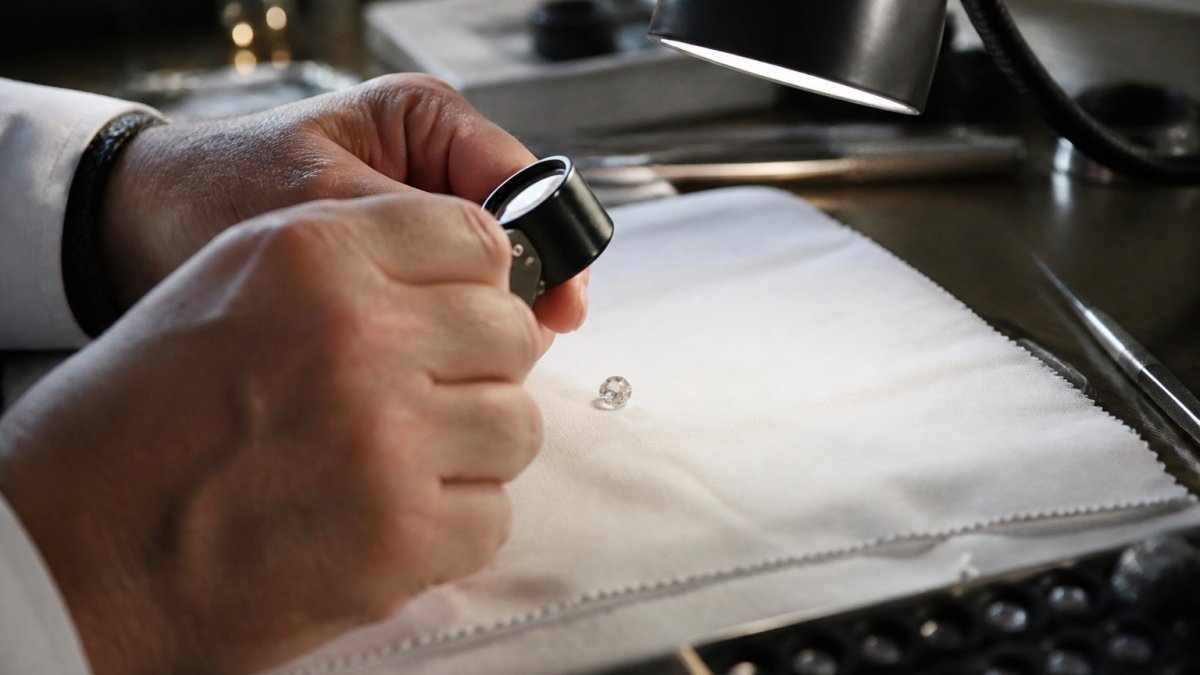
- Set the stone on the dark surface. Place it crown side up, under your bright white light.
- Hold the loupe to your eye. Rest the loupe against your cheek or brow to keep it steady.
- Bring the stone close. Move the stone toward the loupe, rather than moving your head. Keep the stone in focus.
- Start with the table. Look at the flat top surface first. Scan slowly from edge to edge.
- Check the crown and girdle. Look for chips along the edge, called the girdle, and for any cracks.
- Look inside the stone. Angle the stone under the light to see inclusions, which can look like tiny crystals, feathers or clouds.
- Turn the stone over. Inspect the pavilion, the lower part, for cracks or other damage.
- Write down what you see. Note the location and size of any inclusions. Sketch them if that helps.
Give yourself time for each step. Many people rush and miss small inclusions near the edges.
The inspection follows a consistent order, and each step has a clear purpose.
| Step | What to do | Note |
|---|---|---|
| 1. Set the stone | Place it crown side up under bright white light | Use a dark, non-reflective surface |
| 2. Hold the loupe | Rest it against your cheek or brow | Keeps the loupe steady |
| 3. Bring the stone close | Move the stone toward the loupe | Keep the stone in focus |
| 4. Check the table | Scan the flat top edge to edge | Scan slowly |
| 5. Check crown and girdle | Look for chips and cracks | Check the edge closely |
| 6. Look inside | Angle the stone under the light | Spot crystals, feathers or clouds |
| 7. Turn it over | Inspect the pavilion | Look for cracks or damage |
| 8. Record findings | Note location and size of inclusions | Sketch them if helpful |
Diamond Inclusions Visible to the Naked Eye
Some inclusions show up without magnification. These are the ones that most affect how a stone looks, and they are the ones to watch for first.
- Large cracks or feathers: These can show as a thin line across the stone.
- Dark spots or clouds: These can make a stone look grey or lifeless.
- Chips at the edge: Notches on the girdle or table can catch light differently.
- Black or white crystals: Visible near the surface, these can affect brilliance.
Keep in mind that a stone with visible inclusions is not always a poor choice. The size, location and type of inclusion all affect how much it matters. A professional can explain the trade-offs for your specific stone.
Why Professional Diamond Clarity Grading Still Matters
A home check is a useful first step, but it cannot replace an official evaluation. Professional grading uses standardized conditions, trained graders and a written report. That report is what buyers, sellers and insurers rely on.
Professional grading also matters when you are buying, selling or insuring a stone. If you have a family piece or a high-value stone, an expert assessment gives you a reliable record.
At Eklektic, we handle professional jewelry appraisals and work on stones for custom design, repair and restoration. If you want to confirm how a piece was crafted, read how to verify custom jewelry craftsmanship. It explains what to look for when a jeweler tells you about a stone's quality.
Booking Your Diamond Inspection at Eklektic in Houston
If you have a stone you want assessed by a professional, our studio in Houston is ready to help. We can discuss your options for design, repair or restoration. For guidance on choosing a repair shop you can trust, read how to find a reliable jewelry repair shop.
Pricing depends on the work involved, so contact us for a quote. We look forward to helping you understand what your diamond is worth and how to care for it for years to come.
Frequently Asked Questions
How can I check a diamond's clarity at home?
Clean the stone, then examine it with a 10x jeweler's loupe under bright, even light. Look at the table and the pavilion for internal inclusions such as white crystals, feathers and cloud-like clusters, and check the girdle and surface for chips or scratches. Turn the stone slowly and look from several angles. This shows you what is visible, but it cannot produce an official clarity grade. For that, a lab grading report from a recognized laboratory is the reliable reference.
Can you see diamond inclusions with the naked eye?
Some can. Large or dark inclusions, or inclusions near the surface, are sometimes visible without magnification, particularly in larger stones. Most inclusions, however, are small enough that you need a loupe to see them. Because clarity grading is based on magnified inspection, a stone that looks clean to the naked eye may still carry inclusions that a grading laboratory would record.
What magnification do I need to inspect a diamond?
A 10x loupe is the standard tool for a basic inspection, and it is the magnification most often used in professional grading. Lower magnification can miss small inclusions, and very high magnification makes it harder to keep the stone in focus. Use a loupe with a clear, flat lens and hold it close to your eye while moving the diamond toward the lens.
When should I have a jeweler inspect a diamond?
Have a jeweler or grading laboratory inspect the diamond whenever you need a reliable clarity grade, such as before buying, insuring or appraising a stone, or when you are unsure about a chip or crack. A home check can help you spot obvious problems, but a professional inspection with proper equipment and training is the only way to confirm an official grade.
