

Last Updated: November 4, 2026
Quick Summary
Yes, in most cases a jeweler can repair a broken chain. A snapped link or broken clasp is one of the most common repairs a jewelry studio handles. The outcome depends on what broke and how, so a clear look at the break before work begins helps.
- Chains break from wear at the links, stress at the clasp, sudden pulls and repeated bending.
- A jeweler should check the whole chain, since one break can signal other weak spots.
- Bring every broken piece, avoid fixing it yourself, and take a clear photo first.
- Soldering suits most gold and silver chains, while laser welding uses very little heat.
- Ask for the estimate in writing before any work begins.
Table of Contents
- Can a Jeweler Repair a Broken Chain?
- Types of Chains That Are Difficult to Repair
- What to Do Before You Bring in a Broken Chain
- How a Jeweler Repairs a Snapped Chain
- Fixing a Necklace Chain Clasp
- Repair Cost, Timing, and Choosing a Houston Jeweler
- Caring for a Repaired Necklace Chain
- Book Your Chain Repair at Eklektic
- Frequently Asked Questions
Can a Jeweler Repair a Broken Chain?
Yes, in most cases a jeweler can repair a broken chain. A snapped link or a broken clasp is one of the most common repairs a jewelry studio handles. Eklektic Jewelry Studio in Houston handles chain repairs as part of its full-service jewelry repair work.
The useful answer depends on what broke and how. A clean break in a solid link usually gets a clean fix. A chain that has worn thin in several places may need more than one repair. Knowing a little about the break before you visit makes the process faster and the result better.
Why chains break in the first place
Chains break for a few predictable reasons:
- Wear at the links: Friction from rubbing against skin and clothing thins the metal over time.
- Stress at the clasp: Lobster clasps and spring rings take the most pulling force.
- Sudden pulls: Catching a chain on a doorknob or a bag strap can snap a weak link.
- Fatigue from repeated bending: A link that flexes again and again can crack.
Repeated breaks can point to broader wear, so a jeweler should check the whole chain, not only the spot that failed. If one spot broke, others may be close to failing too.
Types of Chains That Are Difficult to Repair
Not every chain is equally easy to fix. Some styles give a jeweler less room to work, and the reason usually comes down to how much metal there is and how much heat the piece can take.
- Very fine or dainty chains: Links under roughly 1mm are hard to hold steady and easy to melt. The jeweler has to work under magnification with a very small flame or a laser, and even then the joint can end up slightly thicker than the surrounding links.
- Hollow chains: Hollow links are formed from thin sheet metal, so there is little material to fuse. Heat can collapse the link or leave a dent, and the repair may be visible even when it holds.
- Plated and gold-filled chains: The outer layer of gold is microns thin. Torch heat can burn it away or cause it to flake at the joint, exposing the base metal underneath. A laser welder reduces the heat spread but does not eliminate the risk on very thin plating.
- Chains with tight, intricate link patterns: Reconnecting a complex link, a box chain, a snake chain, a tightly woven style, can change how the chain lies. A snake chain, for example, is built from closely stacked plates, and a repaired section may not flex the same way as the rest.
- Chains that have broken many times: Each old repair adds solder in one place and can make nearby links stiffer. A chain with three or four previous repairs is often a candidate for replacing a whole section rather than adding a fifth joint.
Watch out: A jeweler who promises a flawless, invisible repair on a hollow or heavily plated chain before examining it under magnification is guessing. The honest answer usually comes after the piece is on the bench.
Stating this up front helps you set realistic expectations. A good jeweler will tell you whether a chain can be repaired well, whether replacing a link or a short section makes more sense, or whether the metal is simply too thin to rejoin safely.
What to Do Before You Bring in a Broken Chain
A little preparation saves time and protects the piece.
- Gather all the pieces. Bring every broken link, charm, and clasp part, even small ones.
- Avoid trying to fix it yourself. Pulling the ends apart or bending the links can make the damage worse.
- Take a clear photo. A picture shows the break and the chain style for your records.
- Note the metal and any stamp. Look for a mark such as 14K, 925, or similar on the clasp or a link.
- Ask about the estimate first. A reputable studio should explain the repair and the cost before starting work.
How a Jeweler Repairs a Snapped Chain
A repair usually follows a few steps. The method depends on the metal, the chain style, and how the break happened.
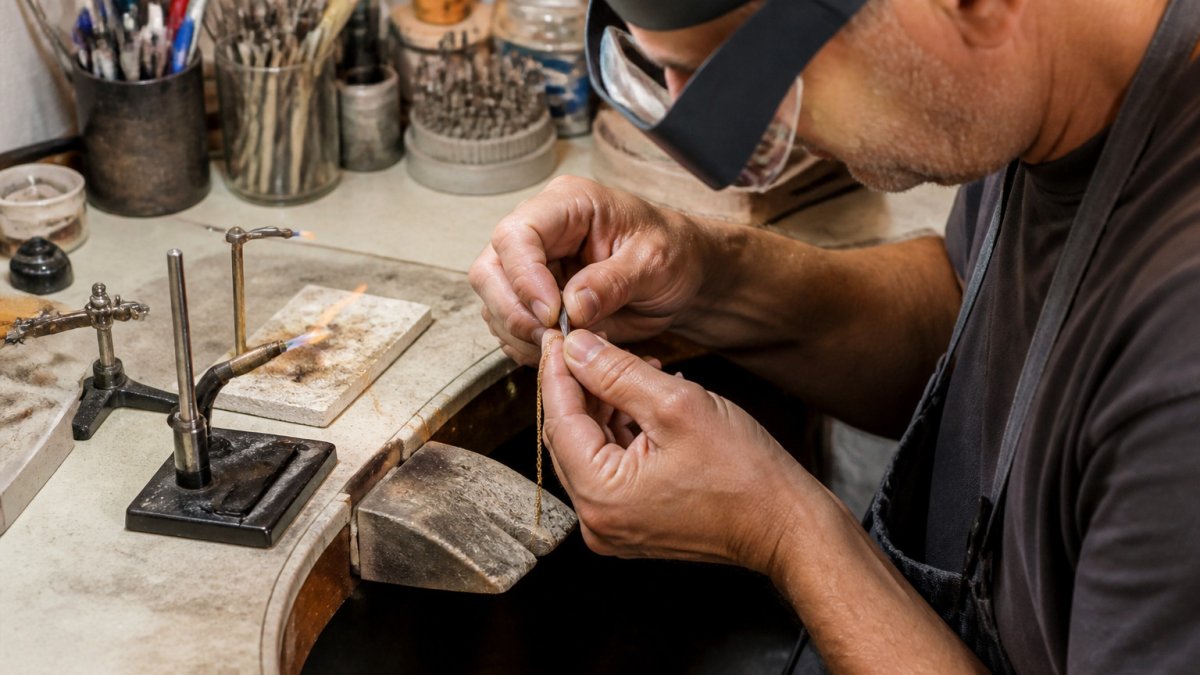
The jeweler first checks the chain under magnification. This reveals how much metal remains at the break and whether nearby links are weak. Then the jeweler chooses a method, most often soldering or laser welding.
Soldering and laser welding
Soldering joins two metal ends with a filler alloy melted by a small torch. It is a traditional, reliable method for most gold and silver chains. Laser welding applies a focused beam to fuse the metal with very little heat spread. Ask which method your jeweler plans to use and why.
When a link needs replacement
Sometimes the metal at the break is too thin or damaged to rejoin. In that case, the jeweler cuts out the damaged section and adds a new link of matching metal and style. A well-matched replacement is usually hard to spot. Ask the jeweler to match the color, thickness, and link pattern so the chain looks even.
The repair method depends on the metal, the chain style and how the break happened. The two main approaches compare as follows.
| Method | Best for | Key difference |
|---|---|---|
| Soldering | Most gold and silver chains | Melts a filler alloy with a small torch |
| Laser welding | Fine chains needing little heat | Fuses metal with very little heat spread |
| Link replacement | Metal too thin or damaged to rejoin | Cuts out the damaged section and adds a matching link |
Fixing a Necklace Chain Clasp
Clasps fail as often as links. A broken lobster clasp or spring ring can often be replaced with a matching part rather than the whole chain. This is usually a quicker and less costly repair. Bring the clasp along with the chain so the jeweler can match the size and style.
Repair Cost, Timing, and Choosing a Houston Jeweler
Ask for the estimate in writing before any work begins, since pricing depends on the piece and the work required. A simple solder on a solid gold or silver cable chain is typically the least involved repair; replacing several links, rebuilding a section of a specialty chain, or working on a very fine piece takes more bench time and usually costs more. Because pricing varies by studio and by piece, ask for the estimate in writing before any work begins, and ask whether the quote includes finishing and polishing.
Turnaround follows the same logic. Ask two questions when you call: whether the studio does the repair in-house, and what the realistic timeline is for your specific chain rather than a general estimate.
When choosing a jeweler in Houston, use these questions to separate a studio that handles chain work routinely from one that treats it as a sideline:
- Do you do chain repairs in-house? A studio with its own bench can control the soldering, finishing, and final inspection.
- How often do you repair this chain style? Experience with fine, hollow, or specialty chains matters more than general jewelry experience.
- Will you inspect the whole chain, not just the break? A good jeweler checks nearby links and the clasp for wear, since one break often signals others close behind.
- Can I see the finished repair under magnification before I pay? Inspecting the joint under a loupe is the simplest quality check.
Watch out: A quote that is dramatically lower than others often means the studio plans to skip finishing or to use a quick solder without checking the rest of the chain. Ask what the quote covers before you compare prices.
For shoppers comparing options, our guide to finding a reliable jewelry repair shop covers what to check before you hand over a valuable piece. You can also read our comparison of custom jewelry studios and jewelry stores for repairs to see which fits your situation.
Caring for a Repaired Necklace Chain
After a repair, a few habits help the chain last:
- Remove the necklace before exercise, swimming, or sleeping.
- Store chains flat or hung separately so links do not tangle and stretch.
- Clean gently with mild soap and warm water, then dry fully.
- Check the clasp every few months for wear.
Choosing a sturdier style for everyday wear also reduces future breaks. Our 14k Diamond Cut Cable Chain 1mm is a versatile option with diamond-cut links, and our 14k Solid Cable Chain 1.1mm is a solid-link chain. Both come in various lengths and colors.


Book Your Chain Repair at Eklektic
If a chain has broken, bring it to our Houston studio and our team will explain the best repair for your piece. We will walk you through the repair before any work begins. Book your chain repair appointment today.
Frequently Asked Questions
How much should it cost to fix a broken necklace chain?
Repair cost depends on the chain's metal, length, and the type of break. A simple reconnection of a solid gold chain costs less than replacing several links or repairing a clasp. Eklektic's 14k Solid Cable Chain 1.1mm is listed at $200.00 and its 14k Diamond Cut Cable Chain 1mm at $215.00 as new purchases, so comparing a repair quote against the price of a replacement chain helps you decide. Ask for an itemized estimate before authorizing work so you know what the repair will cost.
Can a jeweler repair a chain without replacing it?
Often, yes. When the break is at a single link or at the end of a chain, a jeweler can open the damaged link, reshape it, and rejoin it through soldering or laser welding. A chain with a few worn or bent links may also be salvaged by reconnecting intact sections. A chain that is badly stretched, corroded, or has lost many links may need more extensive work.
What should I do before taking a broken chain to a jeweler?
Gather every piece, including the clasp, any loose links, and the pendant if it is attached. Lay the chain flat in a small bag or box so nothing gets lost. Avoid trying to pull or force the ends together at home, since that can deform the links. Note the metal type if it is stamped, and mention whether the chain has sentimental value so the jeweler can choose the gentlest repair method.
