

Table of Contents
- Custom Jewelry Studio vs Jewelry Store: Core Differences
- On-Site Jewelry Repair: What It Means for Your Piece
- Ring Repair and Stone Setting: Complexity and Expertise
- Jewelry Repair Turnaround Time: Studio vs Store
- Questions to Ask a Jeweler Before Repair
- When to Choose a Custom Jewelry Studio Over a Store
- Frequently Asked Questions
Last Updated: October 21, 2026
Custom Jewelry Studio vs Jewelry Store: Core Differences
When your cherished ring needs repair or you're dreaming of a custom piece, understanding custom jewelry studio vs jewelry store matters more than you might think. At Eklektic, we've worked with hundreds of clients who initially weren't sure which path made sense for their needs. The difference between these two options goes far deeper than location or convenience.
A custom jewelry studio is a specialized workspace where artisans design, craft, and repair jewelry on-site using traditional techniques combined with modern technology. A jewelry store typically sells mass-produced or semi-custom pieces and may outsource repairs to external workshops. This distinction shapes everything from the quality of your repair to the timeline and the level of personal attention you receive.
The core difference lies in capability and control. Studios like Eklektic handle the entire process in-house: design, CAD modeling, casting, stone setting, finishing, and repair. Jewelry stores often function as intermediaries, sending work to third-party vendors and waiting for results they can't directly oversee.
For someone in Houston seeking repair work or custom design, understanding these differences helps you avoid common mistakes. You might assume all jewelers are equal. They're not. The choice affects whether your grandmother's ring gets restored with care or treated as a transaction.
On-Site Jewelry Repair: What It Means for Your Piece
On-site repair means the jeweler who assesses your piece is the same person (or works on the same team) who will fix it. This eliminates the handoff problem that plagues traditional retail jewelry stores.
When repair work happens in-house, the jeweler maintains direct responsibility for your piece from start to finish. They see the problem, devise the solution, execute it, and stand behind the result. There's no "it got lost in shipping" or "the vendor interpreted my notes differently" scenario. Your ring stays in one place under one person's care.
This matters most for delicate work. A stone that's loose, a band that's cracked, or vintage settings that require special handling, these projects benefit enormously from a single craftsperson who understands the piece completely. They can make real-time adjustments, catch potential issues before they become problems, and explain exactly what they're doing and why.
Jewelry stores that outsource repairs create friction. Your piece leaves the store, travels to a workshop, sits in a queue, gets worked on by someone unfamiliar with the original design, and returns weeks later. If something goes wrong, responsibility becomes murky. Did the store miss something in the handoff? Did the vendor misunderstand? You're left guessing.
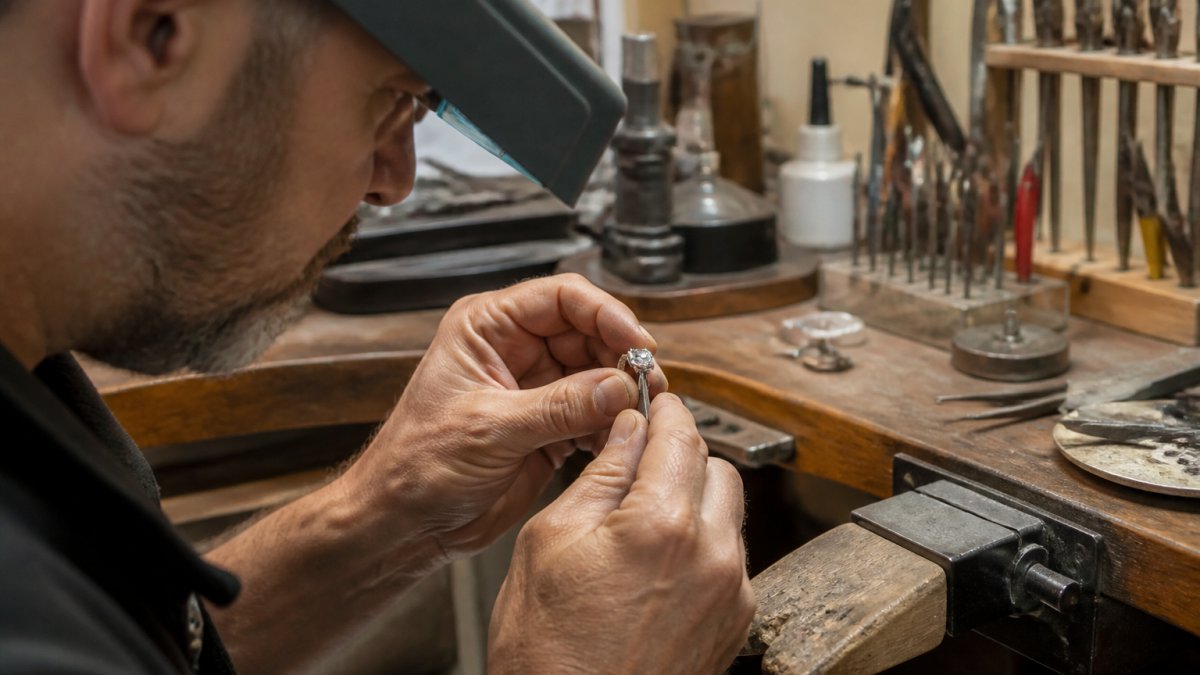
The confidence that comes with on-site repair is worth the search. You're not hoping your piece arrives safely somewhere else. You're watching the work happen in the same studio where your ring will be completed.
Ring Repair and Stone Setting: Complexity and Expertise
Ring repair and stone setting represent some of the most technically demanding jewelry work. Understanding the difference between what a typical store can handle and what a specialized studio can accomplish helps you make the right choice.
Stone setting requires precision that most retail jewelers simply don't practice regularly enough to master. Resetting a diamond, replacing a lost stone, or adjusting a setting demands knowledge of metal behavior, stone stability, and design integrity. A jeweler who sets stones once a month operates at a completely different skill level than one who does it daily.
Ring repair involves multiple variables: the metal type (gold, platinum, sterling silver), the setting style, any stones involved, and the original design intent. A crack in a band might require welding, casting, or careful hand-shaping depending on the metal and the damage. A prong that's bent might need straightening or complete replacement. These decisions require experience and judgment.
Jewelry stores employ generalists. A studio employs specialists. At Eklektic, our team uses laser welding, CAD modeling, and traditional hand-finishing techniques, tools and skills that allow us to solve problems other jewelers can't touch. We regularly handle projects that clients have been turned away from elsewhere.
The complexity also means timeline varies. A simple cleaning takes hours. A stone replacement might take days. A complex repair involving metal work and resetting could take weeks. A studio that does this work in-house can give you realistic timelines because they control the entire process.
Jewelry Repair Turnaround Time: Studio vs Store
Turnaround time reveals the operational differences between studios and stores more clearly than almost anything else.
A jewelry store that outsources repairs operates on someone else's schedule. Your ring goes into a queue. The external vendor works through their backlog. Your piece returns, and the store inspects it. You're looking at two to four weeks minimum, often longer. You have no visibility into where your ring is or what's happening to it.
A custom jewelry studio controls its own timeline. At Eklektic, we typically complete standard repairs within 3-5 business days. More complex work, custom redesigns, intricate stone setting, or restoration of vintage pieces, takes longer, but you know exactly where your piece is and when to expect it back.
The difference matters for practical reasons. You might need your ring for an upcoming event. You might simply want the peace of mind of having your piece back quickly. Or you might have a sentimental item you'd rather not be without for a month.
Transparency also matters. A studio tells you upfront: "This will take ten business days because we're doing X, Y, and Z." A store tells you: "We'll send it out and let you know." You're operating on faith rather than facts.
Here's what most people don't realize: slower isn't always worse. A studio that takes three weeks because they're doing meticulous work is better than a store that returns your ring in two weeks with a sloppy finish. Quality and speed aren't always aligned. A good studio balances both.
Questions to Ask a Jeweler Before Repair
Before you hand over your ring or your custom design project, ask these questions. The answers reveal whether you're working with a studio or a store masquerading as one.
"Do you do this work in-house?" This is the threshold question. If they outsource, you already know the timeline will be longer and accountability will be murky. A studio says yes immediately. A store might hesitate or give you a qualified answer.
"Who will be working on my piece?" A good studio tells you the name and experience level of the person handling your ring. You might even meet them. A store can't answer this because they don't know who the vendor will assign.
"Can you show me examples of similar work?" Portfolio work reveals skill level. Ask specifically for repairs or custom projects similar to yours. If they struggle to find examples, that's a red flag.
"What's your timeline, and what determines it?" A studio gives you a specific range based on the work required. A store gives you a generic estimate because they're waiting on an external vendor.
"What's your process if something goes wrong?" This matters enormously. A studio takes responsibility and fixes it. A store blames the vendor and you're stuck in the middle.
"What happens if I'm not happy with the result?" A studio has skin in the game. They'll adjust, refinish, or redo the work.
"Do you offer a guarantee on your work?" Studios typically guarantee repairs for a set period. Stores can't guarantee work they didn't do.
These questions take five minutes but reveal everything you need to know.
When to Choose a Custom Jewelry Studio Over a Store
The decision comes down to what you're trying to accomplish and how much you care about the outcome.
Choose a studio if:
- Your piece is sentimental or irreplaceable. You can't afford a mistake.
- You need custom design work. You want someone who understands your vision and can execute it.
- You're dealing with vintage or heirloom jewelry that requires specialized knowledge.
- You want to see the work happen and understand the process.
- You need a faster timeline and want visibility into progress.
- You have a complex repair that other jewelers have turned down.
- You want a long-term relationship with someone who knows your pieces.
A jewelry store makes sense if:
- You need basic cleaning or simple adjustments and don't care who does it.
- You want to browse finished pieces and buy something ready to wear.
- You prefer the anonymity of a large retail operation.
- You're budget-conscious and willing to accept longer timelines.
For most people in Houston with valuable pieces or custom aspirations, a studio offers more. You're not paying for retail overhead or middleman margins. You're paying for direct access to the craftsperson and their expertise.
Eklektic exists because we believe jewelry deserves better than the standard retail model. When you work with us, you're not choosing from a display case. You're collaborating with artisans who can design it, make it, repair it, restore it, and help you care for it for years to come. That's the difference a true studio makes.
When your jewelry matters, whether it's an engagement ring you're redesigning, a family heirloom needing restoration, or a custom piece you've been imagining, the choice between a studio and a store shapes the entire experience. At Eklektic in Houston, we combine three generations of custom jewelry expertise with modern techniques like CAD design and laser welding to handle everything from everyday repairs to complex restoration projects. Book an appointment to discuss your piece and discover how working directly with a jewelry studio changes what's possible.
Frequently Asked Questions
What is the difference between a custom jewelry studio and a jewelry store for repairs?
A custom jewelry studio typically handles design, fabrication, and repairs in-house with specialized craftspeople and equipment. A jewelry store may outsource repairs or have limited on-site capabilities. Studios often provide more personalized attention and can tackle complex, unusual projects. Stores offer convenience and may have faster turnaround for standard repairs, but may lack the expertise for intricate work or custom modifications.
Is a custom jewelry studio better for jewelry repairs?
It depends on your repair needs. For standard maintenance like cleaning or sizing, a local jewelry store may be faster and equally effective. For complex work, loose settings, stone replacement, restoration of heirlooms, or custom modifications, a studio with on-site fabrication and specialized craftspeople is often the better choice. Studios can handle difficult problems that retail stores may not be equipped to solve.
What questions should I ask a jeweler before leaving jewelry for repair?
Ask whether the repair is done on-site or sent out, the estimated turnaround time, what the repair includes, whether they can guarantee the work, and how they'll communicate updates. Request a written estimate and ask about their experience with your specific piece type. For valuable or sentimental jewelry, ask about their credentials, insurance coverage, and whether they offer a detailed report of the work performed.
How long does jewelry repair typically take?
Turnaround depends on complexity and workload. Simple repairs like resizing or cleaning may take 1-2 weeks. Stone setting, restoration, or custom work can take 2-4 weeks or longer. Studios doing work in-house may have more control over scheduling but may have longer waits during busy periods. Stores that outsource may quote faster times but have less visibility into the actual process. Always ask for a specific timeline before dropping off your piece.