

Table of Contents
- 7 Risks of Buying Expensive Jewelry Online
- How to Verify a Reputable Retailer Before You Buy
- The Importance of GIA Certification for Diamonds
- Questions to Ask a Jeweler Before Buying
- Benefits of Custom Jewelry Design vs Mass-Produced Pieces
- Secure Payment, Shipping, and Post-Purchase Verification
- Frequently Asked Questions
Last Updated: September 29, 2026
7 Risks of Buying Expensive Jewelry Online
The risks of buying expensive jewelry online fall into seven categories: counterfeits, photo fraud, unverified retailers, missing certifications, unclear return terms, insecure payment, and shipping loss. Each one is manageable, but only if you know what to check before money changes hands. At Eklektic, we handle appraisals, restoration, and custom work daily, and the pieces that arrive in our studio with problems almost always trace back to a skipped verification step.
Here is the uncomfortable truth: most online jewelry listings are not designed to deceive you, but they are designed to be looked at quickly.
1. Counterfeits and Plated Metal Sold as Solid Gold
A "gold" ring that is actually gold-plated brass will not hold its value, will tarnish, and cannot be repaired the way solid gold can. Plated metal is a base metal core with a thin gold layer measured in microns. Once that layer wears through, usually at the prongs and band edges, the piece is finished.
2. Photo Fraud and Inconsistent Visuals
Inconsistent visuals are the single most reliable warning sign in online jewelry. A listing that mixes studio renders with phone photos, or shows the same ring on three different hand sizes, is usually reselling stock images rather than photographing the actual item.
Watch for these tells:
- Gemstone color that shifts noticeably between photos
- No close-up of the hallmark or clasp
- Backgrounds that change mid-listing
- Reviews with customer photos that look nothing like the listing
How to Verify a Reputable Retailer Before You Buy
Verification takes about fifteen minutes and prevents most disputes. Start with the business itself, not the product.
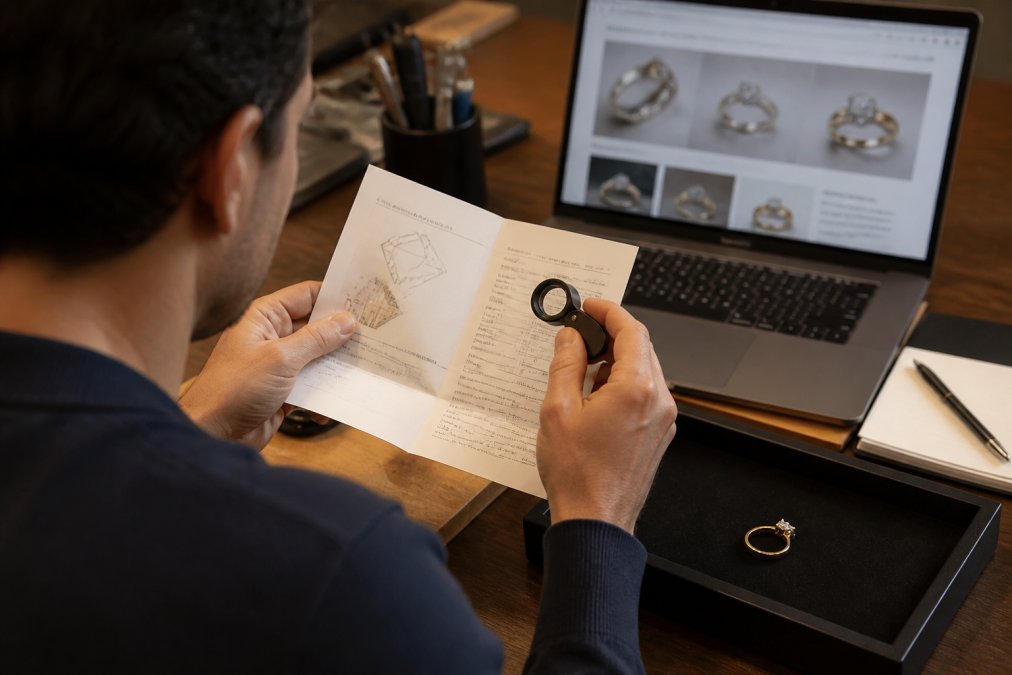
- Confirm a physical business address and a phone number that a human answers. A registered agent address or a virtual mailbox is a warning sign. Call during posted business hours and note whether a person picks up or you get a voicemail box that is never returned.
- Check how long the domain has been registered using a public WHOIS lookup. A storefront domain registered within the last several months, paired with a large inventory and polished branding, is a common pattern in short-lived scam operations. Long registration history is not proof of quality, but very short history is a reason to slow down.
- Read the one-star and two-star reviews first, not the five-star ones. Look for patterns, not isolated complaints. Repeated mentions of "item not as described," "no response after purchase," or "return refused" tell you how the business behaves when something goes wrong.
- Search the business name alongside "complaint" and "lawsuit." Also check the Better Business Bureau profile and any state attorney general consumer complaint database. These are public records and take seconds to search.
- Verify the return window in writing before checkout. Screenshot the policy page and save the confirmation email. Policies that change after purchase are a recurring dispute category.
- Confirm the seller's appraisal and grading claims in writing. Ask which laboratory issued the report and get the report number before you pay.
The manipulation tactics that bypass your checklist
Urgency. Countdown timers, "only one left," "sale ends tonight," and messages like "another buyer is asking about this piece" are designed to compress your decision window below the fifteen minutes verification requires. A legitimate seller of a high-value piece will still be there tomorrow. If a listing pressures you to decide in minutes, treat the pressure itself as the red flag.
The Importance of GIA Certification for Diamonds
GIA certification is the independent grading report that tells you what a diamond actually is, rather than what the seller says it is. The Gemological Institute of America grades cut, color, clarity, and carat weight against a standardized scale, and the report number can be verified directly with the institute.
Questions to Ask a Jeweler Before Buying
Five questions separate a confident purchase from a gamble. Ask them in writing so you have a record.
- What is the exact metal and its weight? "14K yellow gold, 4.2 grams" is an answer. "Solid gold" is not.
- Does this stone have an independent grading report, and what is the number?
- What is your return window, and who pays return shipping?
- Is the piece made in-house or sourced from a third party?
- Will you provide a written appraisal for insurance purposes?
Benefits of Custom Jewelry Design vs Mass-Produced Pieces
Custom jewelry design means the piece is built to your specification rather than selected from existing inventory, and that changes the risk profile of buying online. With a custom commission, you approve the design before fabrication, so you know exactly what you are getting.
Compare the two approaches:
| Factor | Custom Design | Mass-Produced |
|---|---|---|
| Design control | Full, approved before production | Fixed to catalog |
| Sizing | Built to measurement | Standard sizes only |
| Stone selection | You choose the specific stone | Assigned from stock |
| Replacement parts | Reproducible by the maker | Often discontinued |
| Resale | Personal, lower liquidity | Broader market |
Secure Payment, Shipping, and Post-Purchase Verification
Most guides stop at "use a credit card." That is correct but incomplete. The full risk picture has three stages: how you pay, how the package reaches you, and what you do in the first hour after it arrives. The third stage is where almost every buyer loses leverage.
Payment: choose a method with a dispute mechanism
Secure checkout means a payment method with a chargeback path. Credit cards and established payment gateways provide dispute rights; wire transfers, money orders, and peer-to-peer payment apps generally do not. For a high-value purchase, that single choice matters more than any other. If a seller offers a discount for paying by wire, the discount is priced against the risk you are absorbing.
Shipping: insured, signature-required, and tracked
Insist on insured, signature-required delivery with tracking. Shipping insurance protects the seller until delivery and protects you if the package arrives empty or damaged. Note the declared value on the shipping documents; an under-declared package limits the claim you can file.
The post-purchase verification workflow
This is the step almost nobody does, and it is the one that converts a risky purchase into a documented one. Run it in this order, inside the return window:
- Film the unboxing in one continuous take. Start with the sealed package and the shipping label visible, then open it on camera without cutting. Do not stop recording until the piece is out of the box and shown on all sides. This footage is the difference between a resolved claim and a dead end if the contents do not match the listing.
- Photograph the piece against the listing photos. Same angles, same lighting if possible. Side-by-side images make discrepancies obvious and are the evidence a dispute resolution team will actually look at.
- Verify the hallmark and metal weight. A local jeweler or independent appraiser can confirm the metal content and gram weight against the listing in minutes. A postal scale and a loupe will catch obvious mismatches on your own.
- Match the stone to its grading report. Take the report number and verify it directly with the issuing laboratory. Then have an independent appraiser confirm the stone in the setting matches the report, a certificate describes a loose stone, and swapping is a known risk.
- Get a written appraisal for insurance. An appraisal establishes documented market value, which insurers require and which protects you if the piece is lost or stolen. It also forces a professional to commit to a valuation in writing while you are still inside the return window.
Cross-border orders add a separate risk layer
International orders introduce customs duty, import handling fees, and longer transit times. Returns across a border can be slow and expensive, and the customs paperwork is yours to manage. Two specific risks are worth naming:
- Duty and fee exposure. The buyer typically owes import duties and carrier handling fees on delivery. These are not refundable if you later return the piece, so the true cost of a cross-border purchase is higher than the listed price.
- Limited legal recourse. Consumer protection rules and small-claims options are built around domestic transactions. Pursuing a cross-border seller over a misdescribed piece is often impractical regardless of how clear the fraud is.
Frequently Asked Questions
Is it risky to buy an engagement ring online?
It can be, but the risk drops sharply when you buy from a seller who provides independent certification, a written return window, and documented studio practices. Ask whether the center stone has a GIA or AGS report, confirm the metal purity (14k, 18k, platinum), and check that the return policy is in writing before you pay. A seller who cannot answer these basics is a seller to skip.
What are the most common types of fraud when buying jewelry online?
The most frequent problems are plated base metal sold as solid gold, lab-grown or treated stones passed off as natural, stolen product photos reused across fake storefronts, and sellers who vanish after a fraudulent transaction. Chargeback fraud runs the other direction too, which is why legitimate sellers use a secure payment gateway and keep shipping records. Paying by wire transfer or gift card removes your ability to dispute a charge.
How can you verify the authenticity of a gemstone purchased online?
Start with the paperwork: an authenticity certificate or grading report from a third-party lab, matched to the stone's measurements and weight. Once the piece arrives, take it to an independent appraiser for verification. A jeweler with a gemological setup can confirm whether the stone matches the report and check for gemstone impurities or treatments that would change its market value. Do this within the return window so you still have options.
Is it safer to buy custom jewelry from a local studio or a large online retailer?
A local studio gives you a physical address, a person to meet, and a workshop you can visit, which makes post-purchase verification and any later repair far simpler. Large online retailers offer convenience and volume pricing but rarely let you see the bench or the maker. If you are spending a high-value amount on fine jewelry, the ability to walk in and ask questions is worth more than a slightly lower list price.