

Table of Contents
- 1. Get a Professional Appraisal for Inherited Jewelry
- 2. Document Your Inherited Jewelry Thoroughly
- 3. Keep Jewelry Safe at Home with Proper Storage
- 4. Insure Your Valuable Inherited Pieces
- 5. Schedule Regular Heirloom Jewelry Repair and Inspection
- 6. Maintain Clear Ownership Records and Estate Documentation
- 7. Communicate Openly About Inherited Jewelry Distribution
- Protecting Inherited Jewelry for Future Generations
- Frequently Asked Questions
Last Updated: October 13, 2026
1. Get a Professional Appraisal for Inherited Jewelry
A professional appraisal is the foundation of protecting inherited jewelry, establishing true value for insurance and estate planning.
A simple-looking piece may contain valuable gemstones or precious metals; an appraiser examines materials, craftsmanship, and condition to assess it accurately.
Eklektic provides professional appraisals documenting the quality and value of your inherited pieces.
Why appraisals matter:
- Establishes fair market value for insurance purposes
- Provides documentation for estate and tax records
- Helps you understand the true quality of your pieces
The appraiser reviews metal type and weight, gemstone quality and carat weight, craftsmanship, condition, and market prices, then provides a written report for your insurer.
2. Document Your Inherited Jewelry Thoroughly
Documentation turns vague memories into proof of ownership and value, protecting you in disputes and insurance claims.
Photograph each piece from multiple angles, including close-ups of hallmarks or maker's signatures and overall condition.
Record what you know about each piece, origin, prior owners, date, stories.
Create a jewelry inventory that includes:
- High-quality photographs of each piece (front, back, sides, detail shots)
- Written description of materials, condition, and distinctive features
- Appraisal documents with valuations
Keep digital copies in secure cloud storage and print copies in a safe deposit box.
3. Keep Jewelry Safe at Home with Proper Storage
Where you store inherited jewelry matters as much as how, protecting against theft, damage, and loss.
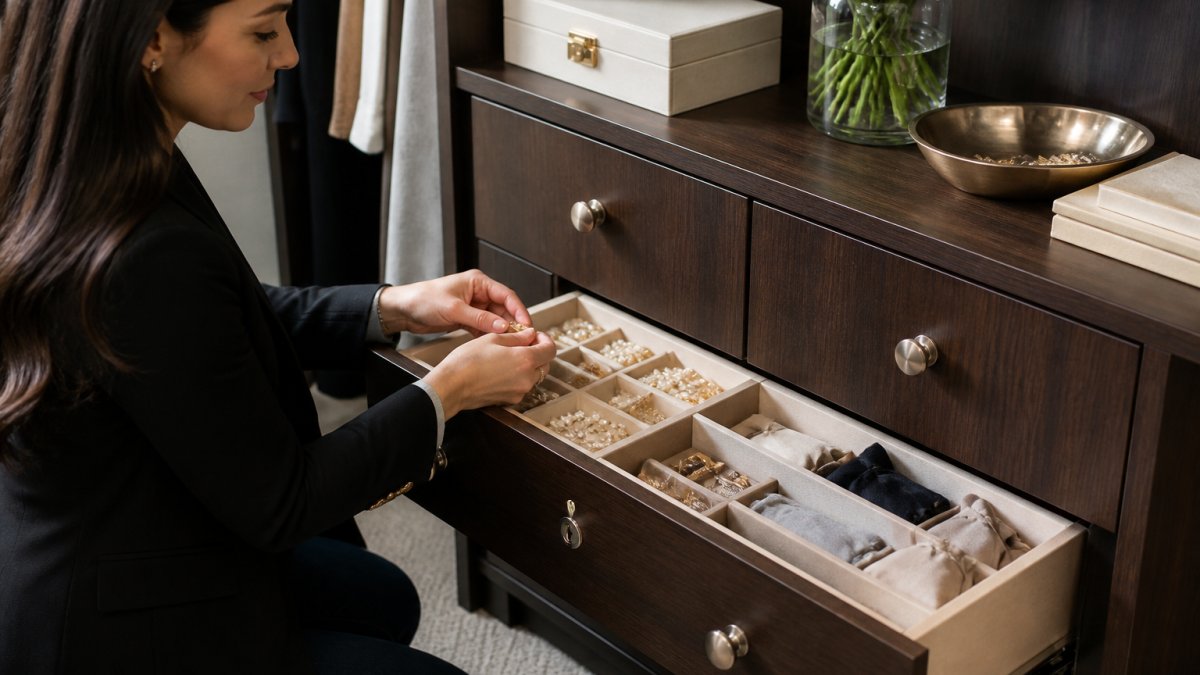
Choosing the Right Storage Method
Your best options are:
Safe deposit boxes at a bank offer the highest security in a vault with limited access, though access is slow; best for pieces you rarely wear.
Home safes work well if bolted to the floor or wall. Choose one rated for jewelry and hide it away from obvious places.
Insurance-backed storage through your insurer or a jewelry studio offers professional-grade protection.
(/products/14kw-ceylan-blue-sapphire-stud-earrings)** like sapphires and rubies resist damage but can chip if knocked hard.Pearls and opals are delicate and need stable humidity and temperature.
Silver tarnishes in air. Store in anti-tarnish bags or boxes. Include anti-tarnish strips to slow oxidation.
Vintage or antique pieces often have mixed materials and delicate settings.
4. Insure Your Valuable Inherited Pieces
Insurance converts an appraisal into financial protection when you protect inherited jewelry: without it, a loss means absorbing the full replacement cost yourself.
Why standard policies fall short
Most homeowners and renters policies treat jewelry as a sub-limited category, capping all jewelry, watches, and furs together at a low threshold, often below the appraised value of a single inherited piece. Standard policies also typically exclude or limit:
- Mysterious disappearance (the piece is simply gone and you cannot prove how)
- Loss during travel, shipping, or while in a hotel safe
- Damage from gradual wear, tarnish, or a broken prong that lets a stone fall out
Those exclusions hit inherited jewelry hardest, since heirlooms are often worn to events or moved between homes.
Scheduled coverage versus blanket coverage
There are two common ways to extend protection, and they behave differently:
Scheduled (itemized) coverage lists each piece by description and appraised value, and the insurer pays that stated amount if it's lost, stolen, or damaged, usually with no deductible or depreciation. Standard for high-value heirlooms because payout is predictable.
Blanket coverage insures a group under one aggregate limit without itemizing. It's simpler and cheaper per piece, but single-item payouts are capped by the blanket limit and any per-item ceiling. Works well for moderate-value collections, poorly for one standout heirloom.
What you need before you call your agent
Insurers generally won't schedule a piece without documentation. Assemble this packet first:
- A recent appraisal report from a qualified appraiser, dated and signed, stating replacement value
- Clear photographs of each piece, including any hallmarks, maker's marks, or engraving
- A written description: metal type, stone type, carat weight, cut, color, clarity, and setting style
Give the agent the appraisal, not a guess. Insurers schedule against documented value, and an under-insured piece pays out only what the policy states.
Exclusions and conditions to read before you sign
Every jewelry policy has conditions that determine whether a claim pays. Ask your agent about:
- Whether 'mysterious disappearance' is covered or excluded
- Whether the policy pays replacement cost or actual cash value (replacement cost is almost always better for heirlooms)
- Whether you must use the insurer's preferred jeweler for repair or replacement
A common pattern: policies pay replacement cost only if you replace the piece; a cash settlement drops the payout to actual cash value, usually far lower for jewelry.
Keep the policy current
Jewelry values move with metal and gemstone markets, so a schedule set five years ago may not reflect today's replacement cost. Review every few years, re-appraise shifted pieces, and update the insurer in writing whenever you add, sell, or gift a scheduled item.
5. Schedule Regular Heirloom Jewelry Repair and Inspection
Inherited jewelry often has wear from years of use. Regular inspection catches problems before they become serious.
Even unworn pieces should be inspected every 2-3 years.
Common problems in inherited jewelry:
- Loose or missing stones from worn settings
- Bent or broken prongs that no longer hold stones securely
- Worn metal that's become thin or fragile
For regular cleaning, use a gentle approach. The American Gem Society's guidance on jewelry care recommends using mild soap and warm water for most pieces.

Eklektic offers professional jewelry repair and restoration for inherited pieces, preserving original character and value, from tightening loose stones to full restoration of vintage settings.
6. Maintain Clear Ownership Records and Estate Documentation
Documentation does two jobs: it proves what you own today and controls who owns it tomorrow. Inherited jewelry sits at the intersection of property law and family expectations, so both matter.
The ownership paper trail
Keep these records together so a claim, dispute, or probate filing never depends on memory:
- The will, trust, or estate document that transferred the jewelry to you, or a certified copy if the original is filed with the court
- The executor's distribution letter or receipt if the estate distributed pieces informally
- Appraisal reports with dates and appraiser credentials
Store originals in a safe deposit box or home safe, keep working copies at home, and tell a trusted family member where the originals live.
How jewelry actually passes to the next owner
Jewelry can transfer by several legal routes, and the route determines what documentation matters:
Specific bequest in a will. The will names the piece and recipient. Cleanest route, but only works if the will is valid, the piece is still in the estate, and the description identifies the item.
Residuary clause. The will gives the 'rest and remainder' to beneficiaries.
Trust. A revocable living trust can hold jewelry and direct distribution outside probate, avoiding the public court process.
Beneficiary designation. Financial accounts and life insurance pass by designation, but physical jewelry generally does not, it passes through the will, trust, or estate.
Gift during life. Handing a piece to a family member transfers ownership immediately and removes it from your estate.
The executor's role and probate
If you're the executor of an estate with jewelry, your job is to identify, value, safeguard, and distribute pieces per the will and state law. Practical steps:
- Locate and inventory all jewelry promptly, ideally with a witness present
- Photograph and describe each piece before it leaves the home
- Store valuable pieces securely until distribution, do not leave them in an empty house
Probate is state-level: rules and small-estate thresholds vary widely, so this is where a local estate attorney earns their fee.
Written family agreements
When the will is silent or ambiguous, a written family agreement signed by all heirs can prevent a dispute from becoming a lawsuit. It can state:
- Which pieces go to which person
- How pieces of unequal value will be balanced (cash, other property, or waived claims)
- What happens if a piece is later sold or gifted outside the family
A family agreement isn't a substitute for a will, but it resolves gray areas. Have an attorney review it before anyone signs.
Keep your own plan current
If you plan to pass inherited jewelry on, update your will or trust to name specific pieces and people. Vague language like 'my jewelry to be divided among my children' invites the same disputes you inherited. Be explicit, review after major life changes, and tell your executor where the documentation lives.
7. Communicate Openly About Inherited Jewelry Distribution
Family disagreements over inherited jewelry often stem from unclear expectations. Open communication prevents resentment and protects relationships.
If you're the executor, follow the deceased's wishes as stated in the will.
Tips for difficult conversations:
- Start early, before emotions are high
- Be clear about the jewelry's value and provenance
- Listen to what matters to each family member
Sometimes the fairest solution isn't equal monetary value. One person might receive a diamond ring they've always loved while another gets a bracelet of equal value.
Protecting Inherited Jewelry for Future Generations
Inherited jewelry connects you to your family's past. Protecting it ensures you can pass those connections forward.
When you're ready to have inherited pieces inspected, repaired, or restored, Eklektic can help.
Your inherited jewelry deserves care that honors its history and value.
Book an appointment with Eklektic to discuss how we can help protect and care for your inherited pieces.
Frequently Asked Questions
How often should inherited jewelry be inspected?
Inherited jewelry should be professionally inspected at least once per year, or every six months for pieces worn frequently. Annual inspections catch loose stones, worn prongs, and metal fatigue before they cause damage. If you notice visible wear, discoloration, or loose settings between scheduled inspections, have a professional jeweler examine the piece immediately to prevent loss or further deterioration.
Should inherited jewelry be appraised, and how much does it cost?
Yes, inherited jewelry should be appraised for insurance purposes, estate documentation, and to understand its true market value versus sentimental worth. Professional appraisals typically cost $75-$200 per piece, depending on complexity and materials. The appraisal report becomes essential for insurance claims and provides a baseline for future estate planning or distribution decisions among family members.
Can inherited jewelry be cleaned at home?
Some inherited jewelry can be safely cleaned at home using gentle methods, but delicate or valuable pieces require professional care. A plant-based jewelry cleaner like our Natural Cleaning Spray works well for diamonds and most metals, but pearls, opals, and turquoise need extra caution. For heirloom pieces with uncertain provenance or sensitive gemstones, professional cleaning ensures no damage occurs and preserves the piece's integrity.
How do you divide inherited jewelry fairly among family members?
Fair distribution requires clear communication before disputes arise. Document each piece's value through professional appraisal, then consider sentimental attachments alongside monetary worth. Some families divide by alternating choices, others by equal dollar value, and some designate specific pieces to specific heirs in writing. If conflict emerges, a neutral third party or family mediator can help reach agreement that honors both the jewelry's value and family relationships.