

Table of Contents
- What Are Lab-Grown Diamonds and How Do They Differ?
- Price Comparison: Lab-Grown vs Natural Diamonds
- Diamond Certification Standards: GIA vs IGI
- Lab-Grown Diamond Resale Value and Long-Term Depreciation
- Durability, Hardness, and Physical Properties
- How to Choose a Diamond for Custom Jewelry
- Ethical and Environmental Considerations
- Frequently Asked Questions
Last Updated: September 26, 2026
What Are Lab-Grown Diamonds and How Do They Differ?
Lab-grown diamonds are created in controlled laboratory environments rather than formed naturally over billions of years in the Earth's mantle. When comparing lab grown vs natural diamonds, both are chemically and optically identical, pure carbon in a crystal lattice structure despite their different origins. The key distinction lies in production method and timeframe.
Lab-grown diamonds use two primary methods: CVD (chemical vapor deposition) deposits carbon layers onto a seed in a chamber, while HPHT (high pressure, high temperature) applies extreme pressure and heat to mimic Earth's conditions. Both produce genuine diamonds with identical physical and optical properties to mined stones.
The primary difference is origin and cost. Natural diamonds form over 1-3 billion years beneath the Earth's surface; lab-grown diamonds are produced in weeks to months. Lab-grown stones typically cost 40-60% less than natural counterparts of comparable quality.
Price Comparison: Lab-Grown vs Natural Diamonds
Lab-grown diamonds typically cost 40-60% less than natural diamonds of comparable quality. Understanding production methods and cost structures reveals important distinctions for your budget.
Production Method and Cost Structure
CVD diamonds grow slowly (1-3 carats per week) but require less energy per carat; HPHT diamonds form faster but demand more electricity. This energy difference affects wholesale pricing: HPHT stones often cost slightly less at retail due to shorter production cycles, though both methods produce chemically identical diamonds.
Natural diamond pricing reflects extraction costs, supply chain markup, and scarcity premiums.
Price Variation Within Lab-Grown Diamonds
CVD diamonds sometimes carry a premium over HPHT equivalents due to historically fewer color tints, though modern HPHT technology has narrowed this gap. GIA-certified lab-grown diamonds command higher prices than IGI-certified stones of identical specifications.
Wholesale vs. Retail Pricing
Natural diamonds carry markup from wholesale to retail; lab-grown diamonds carry markup through newer channels. This means the price advantage is partially a retail-channel advantage.
Budget Allocation Strategy
Lab-grown savings can be redirected toward cut quality or carat weight. Lab-grown savings can be redirected toward cut quality or carat weight.
Lower price doesn't mean lower quality. A lab-grown diamond with excellent cut, high clarity, and near-colorless color performs identically to a natural diamond with the same specifications.
Diamond Certification Standards: GIA vs IGI
Both GIA and IGI certify lab-grown and natural diamonds using the same grading criteria and evaluate the four Cs: carat weight, clarity, color, and cut. Both diamonds rate 10 on the Mohs hardness scale.
GIA certification is considered the gold standard and is widely recognized by jewelers, appraisers, and buyers. IGI certification is also reputable, particularly for lab-grown diamonds. Some buyers perceive GIA grades as slightly more conservative than IGI grades.
Both organizations clearly mark certificates to indicate origin. Lab-grown diamonds should never be sold without disclosure. Ensure your diamond comes with proper certification and clear documentation of its origin.
Certification involves analysis of optical properties including refractive index and dispersion, giving you confidence in quality regardless of origin.
Lab-Grown Diamond Resale Value and Long-Term Depreciation
This is where lab grown vs natural diamonds diverge most significantly, and understanding the mechanics, not just the percentages, is critical for long-term financial planning.
Natural Diamond Depreciation Curve
Natural diamonds depreciate in the first year, then stabilize. They retain a portion of original retail value after 5-10 years. This reflects the retail markup built into the original price, you're shedding the retail margin when entering the secondary market.
Natural diamonds depreciate annually after the initial drop. The curve flattens due to established demand, scarcity, and historical prestige.
Lab-Grown Diamond Depreciation Curve
Lab-grown diamonds face steeper depreciation as global production capacity expands. They lose a portion of retail value in the first year and retain a portion after 5-10 years. The depreciation curve is less stable because the secondary market is still maturing.
Lab-grown diamonds depreciate faster due to supply dynamics, not quality. As more lab-grown stones enter the secondary market, buyers prefer new stones at lower prices over used ones, pushing resale values downward more aggressively than natural diamond supply.
The trajectory is less predictable as the market establishes pricing norms.
Insurance and Appraisal Implications
Depreciation affects insurance costs and appraisal values. Lab-grown diamonds depreciate faster, so insured value drops more quickly, reducing both premiums and coverage.
Natural diamond appraisals reflect rarity and market demand, supporting higher values over time. Lab-grown appraisals are more conservative due to supply growth and market uncertainty. A lab-grown diamond appraised at purchase might be appraised at a lower value five years later due to market shifts, creating a coverage gap if you don't update appraisals regularly.
Investment Perspective vs. Personal Enjoyment
For investment purposes, natural diamonds offer better value preservation and predictable depreciation. A natural diamond likely retains a portion of its value in five and ten years, a stable trajectory for financial planning.
Lab-grown diamonds are not suitable as investment vehicles due to steep, unpredictable depreciation. However, for personal enjoyment in engagement rings or custom jewelry, they deliver exceptional value since you're not paying the scarcity premium that drives natural diamond prices.
Market Maturation and Future Depreciation
The lab-grown market is in growth phase. As production stabilizes and consumer acceptance increases, depreciation curves may eventually flatten. However, current buyers should assume steeper depreciation and plan accordingly.
The secondary market for lab-grown diamonds is still developing. Jewelers and appraisers are establishing consistent pricing for lab-grown resale, but standardization lags behind natural diamond markets. This uncertainty itself drives faster depreciation because buyers discount lab-grown stones to account for resale risk.
Durability, Hardness, and Physical Properties
Both lab-grown and natural diamonds score 10 on the Mohs hardness scale, meaning they're equally durable for everyday wear in engagement rings and custom jewelry. Durability isn't a differentiator, both will scratch only with other diamonds and resist damage from normal use for generations.
The optical properties are identical. Both exhibit the same refractive index, meaning light bends through them identically. Both show the same dispersion, creating the characteristic sparkle and fire. A skilled jeweler cannot visually distinguish a lab-grown diamond from a natural diamond without specialized equipment, and even then, only through fluorescence testing or trace element analysis.
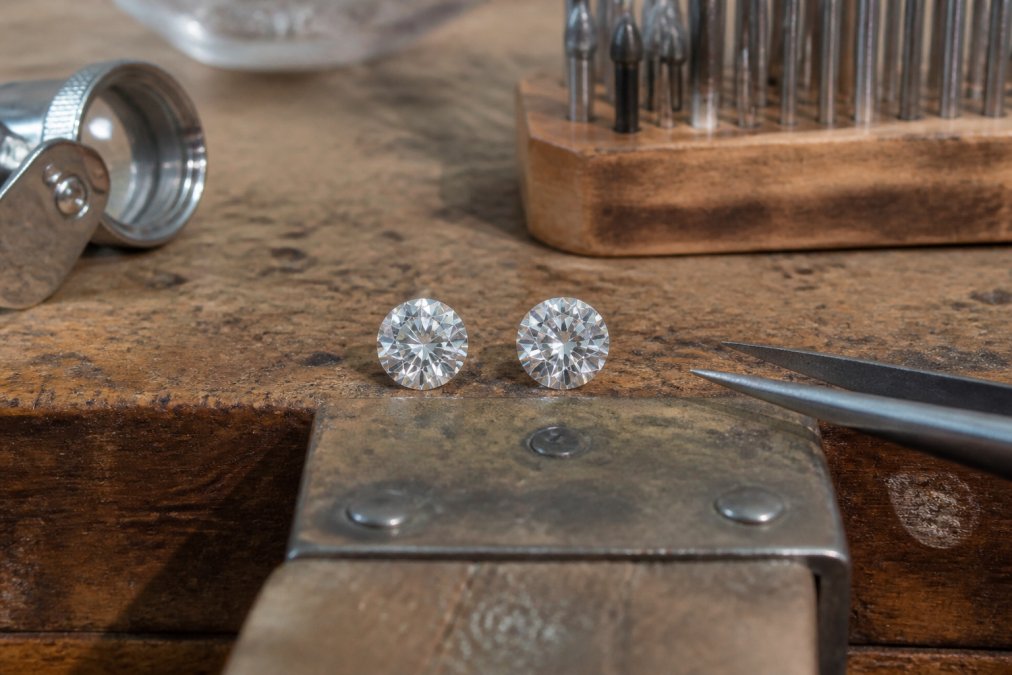
Physical properties like specific gravity and refractive index are mathematically identical. Both diamonds will perform the same in any jewelry setting. If durability and wearability are your concerns, both options are equally suitable for heirloom pieces meant to pass through generations.
The only physical difference lies in growth patterns. Lab-grown diamonds may contain trace elements or growth patterns that differ from natural diamonds, but these don't affect durability or appearance to the naked eye. For practical jewelry purposes, this distinction is irrelevant.
How to Choose a Diamond for Custom Jewelry
Start by clarifying your priorities. Are you optimizing for budget, ethical sourcing, investment value, or personal preference?
Request GIA or IGI certification for whichever type you choose. Certification provides transparency on carat weight, clarity grade, color grade, and cut quality, ensuring you understand exactly what you're purchasing.
Ethical and Environmental Considerations
Lab-grown diamonds offer clear ethical advantages. Mining natural diamonds involves significant environmental disruption, water usage, and carbon footprint. Lab-grown production requires energy input but eliminates mining-related habitat destruction and avoids potential conflict-free sourcing concerns that sometimes cloud natural diamond sourcing.
Frequently Asked Questions
Are lab-grown diamonds chemically identical to natural diamonds?
Yes. Lab-grown diamonds have the same chemical composition (carbon atoms arranged in a cubic crystal structure) and physical properties as natural diamonds. Both rate 10 on the Mohs hardness scale and exhibit identical optical properties like refractive index and dispersion. The only meaningful difference is origin: lab-grown diamonds are created in controlled environments using CVD or HPHT technology, while natural diamonds formed over billions of years underground. A gemological laboratory cannot distinguish them based on chemistry alone.
How does the resale value of lab-grown diamonds compare to natural diamonds?
Lab-grown diamonds depreciate more steeply than natural diamonds. Natural diamonds maintain a portion of their original purchase value after resale, while lab-grown diamonds typically retain a smaller portion. This gap exists because lab-grown diamond production costs continue to drop as technology improves, increasing market supply and reducing scarcity value. Natural diamonds derive value partly from geological rarity and established market demand. If investment potential matters for your custom jewelry, natural diamonds are the stronger choice. For sentimental or wearable pieces, lab-grown diamonds offer significant upfront savings.
What is the primary downside of choosing a lab-grown diamond?
The main drawback is poor resale value and limited liquidity. Lab-grown diamonds are newer to the market, and secondary markets for them remain underdeveloped compared to natural diamonds. Jewelers and pawn shops often offer substantially lower buyback prices for lab-grown stones. Additionally, as production technology advances and supply increases, prices for lab-grown diamonds continue to decline, which can erode the value of your piece over time. This matters most if you view your diamond as a financial asset rather than purely as a personal or sentimental keepsake.
How do I choose between lab-grown and natural diamonds for a custom piece?
Start by clarifying your priorities: budget, intended use, and whether future resale matters. Lab-grown diamonds cost less than natural diamonds of comparable carat weight, clarity grade, color grade, and cut quality, making them ideal if you want a larger stone within a fixed budget. Choose natural diamonds if you value investment potential, prefer established market resale options, or want a piece that will hold heirloom status. Both are equally durable for everyday wear. For custom jewelry, work with a jeweler who can explain the GIA or IGI certification and grading for your chosen stone, and discuss whether you want conflict-free sourcing or other ethical considerations.