

Table of Contents
- Lab-Grown vs. Mined Diamonds: What's the Real Difference?
- Price Difference and Value Retention: Lab-Grown Diamond Resale Value
- Ethical and Environmental Advantages
- Affordable Alternatives to Diamond Engagement Rings
- How to Choose a Lab-Grown Diamond
- The Real Drawbacks: What Matters Before You Buy
- Conclusion: Is Lab-Grown Diamond Jewelry Worth the Investment?
- Frequently Asked Questions
Last Updated: October 2, 2026
Lab-Grown vs. Mined Diamonds: What's the Real Difference?
Understanding whether lab grown diamond jewelry worth your investment comes down to knowing what you're actually buying. A lab-grown diamond is chemically identical to a mined diamond, same carbon lattice structure, same optical properties, same hardness on the Mohs scale. The difference lies entirely in how they form and what that means for your wallet and conscience.

The distinction matters more than many retailers acknowledge. Lab-grown diamonds reach the same physical durability as mined stones, with identical brilliance, fire, and scintillation. Yet the path to the jeweler's bench is fundamentally different.
How Lab-Grown Diamonds Are Made
Lab-grown diamonds are created through High Pressure High Temperature (HPHT) or Chemical Vapor Deposition (CVD). HPHT applies intense pressure and heat to a diamond seed, causing carbon to crystallize around it. CVD, the more common method, deposits carbon atoms layer by layer in a vacuum chamber. Both produce real diamonds with identical atomic structure to mined stones.
The industrial production process matters because it's faster and more predictable than mining. You get a diamond with fewer impurities in many cases, which translates to eye-clean stones at smaller price points. This is why lab-grown diamonds appeal to budget-conscious buyers without sacrificing quality.
Chemical and Physical Properties
Chemically, lab-grown and mined diamonds are indistinguishable, both pure carbon in a cubic crystal structure. A gemologist cannot tell them apart using standard testing methods; specialized equipment detecting trace elements from industrial production is required.
Physically, they perform identically. Both score 10 on the Mohs hardness scale, resist scratching, and withstand daily wear.
Both can be graded and certified by the Gemological Institute of America (GIA) or International Gemological Institute (IGI) using the same 4 Cs: carat weight, cut quality, color, and clarity grade.
Price Difference and Value Retention: Lab-Grown Diamond Resale Value
The price difference is substantial. Lab-grown diamonds typically cost 40-60% less than mined diamonds of comparable quality. A 1-carat, VS1 clarity, excellent-cut mined diamond might cost $4,000-$6,000. The same specs in a lab-grown stone runs $1,500-$2,500.
This gap exists because mined diamonds are constrained by geology and mining capacity, while lab-grown diamonds are produced on demand, driving prices down as production becomes more efficient.
The Resale Reality
Lab-grown diamonds typically retain a lower percentage of their purchase price when resold compared to mined diamonds. This matters if you view the diamond as an investment or heirloom. For personal pieces worn for decades, resale value is less relevant. But if you might sell or trade later, lab-grown's lower resale value is a real drawback.
Insurance and Appraisal Complications
Insurance and appraisal present unexpected friction. Some insurers may have specific requirements for insuring lab-grown diamonds, potentially requiring separate riders or specialized appraisals. It's advisable to clarify coverage details with your provider.
Appraisals for lab-grown diamonds can vary, which may affect insurance claims and estate planning.
Before purchasing, contact your insurance provider to confirm coverage and any riders required. Ask about specialized appraisal requirements or caps on lab-grown coverage, as these can affect your true cost of ownership.
Obsolescence Risk
Lab-grown technology is improving, and this may impact the desirability and resale value of older stones over time. Mined diamond values are generally more stable due to constrained supply.
Ethical and Environmental Advantages
Lab-grown diamonds have a clear ethical edge. Mining involves environmental disruption, habitat loss, water pollution, and significant carbon emissions. Lab-grown diamonds are produced in controlled facilities with minimal environmental footprint and no conflict diamond risk. Labor practices are more transparent with no supply chain opacity.
The environmental advantage isn't absolute, production requires electricity, which may involve fossil fuels depending on the power grid. Ask your jeweler about supplier energy sources if sustainability is a priority.
Affordable Alternatives to Diamond Engagement Rings
Moissanite, made from silicon carbide, is harder than diamond (9.25 on the Mohs scale) and costs 80-90% less, though it has more fire (rainbow sparkle). Cubic zirconia is cheaper but scratches and clouds over time, making it unsuitable for long-term wear.
For custom designs, work with a jewelry studio that can design around your budget. Using lab-grown diamonds keeps costs accessible while maintaining quality and personalization.
How to Choose a Lab-Grown Diamond
Understanding Grading and Certification
Insist on a graded lab-grown diamond from GIA or IGI. Certification confirms specs and authenticity; without it, you're trusting the seller's word.
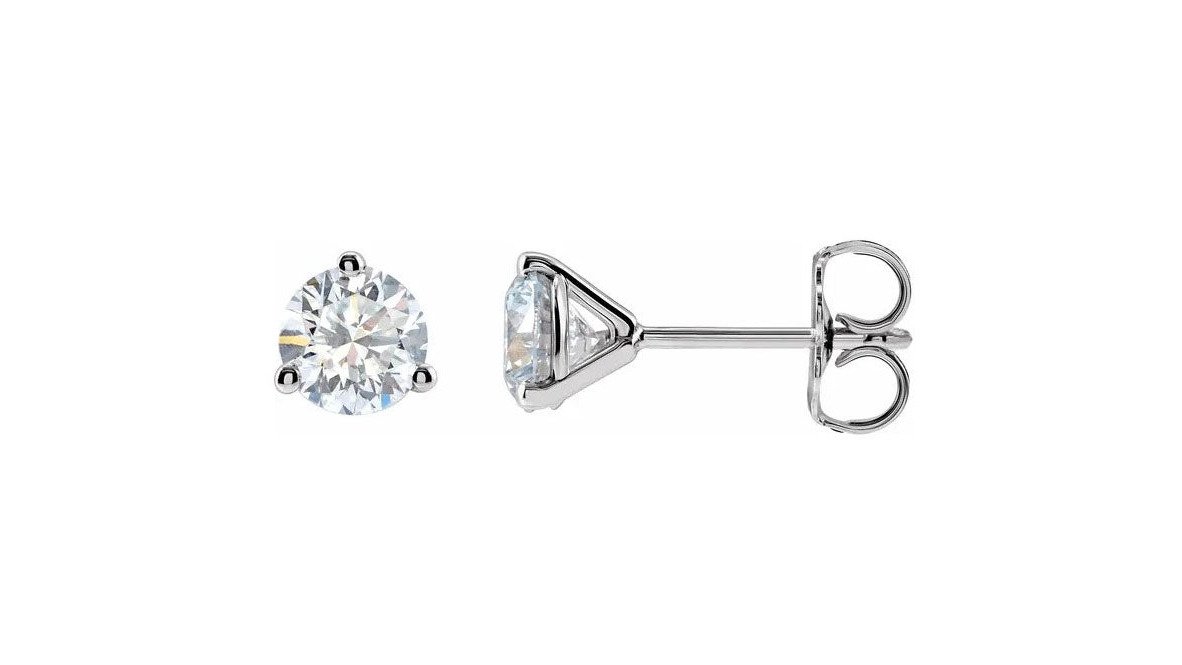
Lab-grown diamonds often receive higher clarity grades than mined stones because controlled production introduces fewer inclusions. You can find eye-clean SI1 lab-grown diamonds at lower prices than equivalent mined stones.
When reviewing the certification, focus on the 4 Cs. For engagement rings, aim for eye-clean clarity (SI1 or better), which means no inclusions visible to the naked eye.
14kw LG Diamond Studs 3mm 1/5cttw →
Carat weight is the most visible spec, but it's not the whole story. A well-cut 0.9-carat diamond often looks larger and more brilliant than a poorly cut 1.0-carat stone.
Setting and Metal Choices for Lab-Grown Diamonds
The setting amplifies or diminishes how your diamond looks, and certain settings work better with lab-grown stones than others.
A solitaire setting puts all focus on the stone's brilliance and is ideal if you've selected a high-quality cut.
Three-prong and four-prong settings expose more of the diamond's surface, allowing maximum light return and sparkle.
Metal choice affects the overall aesthetic and, subtly, how the diamond appears.
For lab-grown diamond studs, Eklektic offers options like the 14kw LG Diamond Studs 4.5mm 3/4cttw at $997, which delivers substantial carat weight in a versatile white gold setting.
Practical Buying Checklist
Before finalizing your purchase, confirm:
- Certification source: GIA or IGI only; verify the certificate number on the lab's website.
- Clarity grade: SI1 or better for engagement rings; VS2 is acceptable if eye-clean.
- Cut quality: Excellent or Very Good; this matters more than color or carat weight.
- Color grade: D-H is ideal; J and below may show visible warmth.
- Insurance eligibility: Contact your insurer before purchase to confirm coverage and any riders required.
- Return or exchange policy: Confirm you can return or exchange within a reasonable timeframe if the stone doesn't meet expectations in person.
- Setting durability: Ask whether the setting is designed for daily wear and whether prongs will be checked annually.
The Real Drawbacks: What Matters Before You Buy
Lab-grown diamonds aren't perfect for everyone. The resale value gap is real. If you buy a lab-grown diamond expecting to recoup 50% of your investment later, you'll be disappointed. Plan on 20-30% at best.

There's also the obsolescence risk. Lab-grown technology is improving rapidly, which means older lab-grown diamonds may become less desirable as newer, cheaper, higher-quality stones flood the market. A mined diamond's value is more stable because supply is constrained.
Certification nuances matter too. Not all grading labs are equivalent. GIA is the gold standard, but IGI certifications are also reputable. Some smaller labs have less stringent standards. Always verify the certifying organization before buying.
Finally, consider your long-term vision. If this ring is meant to pass to your children or grandchildren, a mined diamond carries cultural weight and established resale value.
| Consideration | Lab-Grown Diamond | Mined Diamond |
|---|---|---|
| Price Point | 40-60% less | Higher upfront cost |
| Resale Value | 20-30% retention | 50-60% retention |
| Ethical Sourcing | Clear advantage | Conflict diamond risk |
| Environmental Impact | Lower footprint | Mining disruption |
| Durability | Identical | Identical |
| Certification | GIA/IGI available | GIA/IGI standard |
| Investment Potential | Limited | Established market |
| Suitability for Heirlooms | Good with caveats | Traditional choice |
Conclusion: Is Lab-Grown Diamond Jewelry Worth the Investment?
Lab grown diamond jewelry worth purchasing if your priorities align with value, ethics, and personal enjoyment over investment returns. You get a real diamond, chemically and physically identical to a mined stone, at a fraction of the cost.
Where it falls short: if you're buying for resale potential or creating a true heirloom meant to appreciate, mined diamonds remain the safer choice.
The real decision isn't lab-grown versus mined. It's whether you're buying a personal piece or an investment, and whether ethics matter more than resale value. Once you answer those questions, the choice becomes clear.
At Eklektic, we design custom jewelry around your values and budget. Whether you choose lab-grown or mined diamonds, we create pieces that last generations. Our team works directly with you from sketch to finished ring, ensuring the final piece matches your vision. Book an appointment to explore lab-grown diamond options in a custom setting designed just for you.

When you're ready to invest in a piece that reflects your values, Eklektic brings three generations of jewelry-making expertise to every custom design. We source lab-grown diamonds certified by GIA, set them in 14k gold or platinum, and handle everything from initial sketching to final finishing right here in our studio. Our lab-grown diamond studs start at $315, offering real quality at accessible prices. Work with a jewelry studio that designs, makes, and stands behind every piece.
Frequently Asked Questions
Are lab-grown diamonds chemically identical to natural diamonds?
Yes. Lab-grown diamonds have the same carbon lattice structure and physical properties as mined diamonds. The only difference is origin: lab-grown stones are created in a controlled environment in weeks or months, while natural diamonds form over billions of years underground. A professional jeweler cannot distinguish between them without specialized equipment, and both will score 10 on the Mohs hardness scale.
Do lab-grown diamonds hold their resale value?
Lab-grown diamonds depreciate more than mined diamonds. Because supply is increasing and production costs continue to drop, resale value is lower and less predictable. If you're buying for investment potential, mined diamonds retain value better. However, if you're buying for personal wear, the lower upfront cost often offsets depreciation concerns. Focus on the piece itself rather than future resale.
What is the main downside of lab-grown diamonds?
The biggest drawback is resale value. Lab-grown diamonds typically resell for a lower percentage of their original purchase price compared to mined diamonds. Additionally, as production technology improves and becomes more common, lab-grown diamonds may become less desirable to future buyers. Insurance and appraisal can also be more complex since the market for lab-grown stones is still developing.
How much do lab-grown diamond studs cost compared to mined diamonds?
Lab-grown diamond studs typically cost 30-40% less than comparable mined diamond studs. For example, a 0.75-carat lab-grown diamond stud in 14k white gold runs around $997, while a similar mined diamond would cost significantly more. This price advantage makes lab-grown stones ideal if you want larger carat weight or multiple pieces without stretching your budget.