

Table of Contents
- What $1000 Actually Buys in an Engagement Ring
- Affordable Alternatives to Diamond Engagement Rings
- The Custom Engagement Ring Design Process
- How to Choose a Durable Engagement Ring Setting
- Sentimental Value vs. Resale Value
- Lab-Grown Diamonds and Gemstone Quality at This Price Point
- Is $1000 Enough? Making the Decision
- Frequently Asked Questions
Last Updated: October 7, 2026
What $1000 Actually Buys in an Engagement Ring
An engagement ring cheap enough at $1000 is still a thoughtful investment, not a compromise. The question "Is a $1000 dollar engagement ring cheap?" misses the point. What matters is what you're actually purchasing and whether it aligns with what you want your ring to represent.
At $1000, quality becomes visible and meaningful. You can secure a lab-grown diamond with excellent clarity and cut, a genuine gemstone center stone with real sparkle, or a custom design that reflects your style. The metal, gold, platinum, or sterling silver, will be genuine and durable. This is a real engagement ring built to last.

The real conversation isn't whether $1000 is cheap, but whether it's enough for what you want, which depends on your priorities: stone size, metal type, design complexity, and whether you buy mass-produced or custom.
Affordable Alternatives to Diamond Engagement Rings
Lab-grown diamonds have changed what $1000 buys. At this price point, a lab-grown diamond delivers the same optical and physical properties as a mined diamond, identical crystal structure, same hardness, same sparkle, for significantly less.
Beyond lab-grown diamonds, several gemstone alternatives offer stunning visual impact at this budget:
Moissanite offers a different sparkle, more rainbow fire than diamond brilliance. Some love this distinctive look; others find it too flashy. It's durable and affordable, popular with budget-conscious buyers.
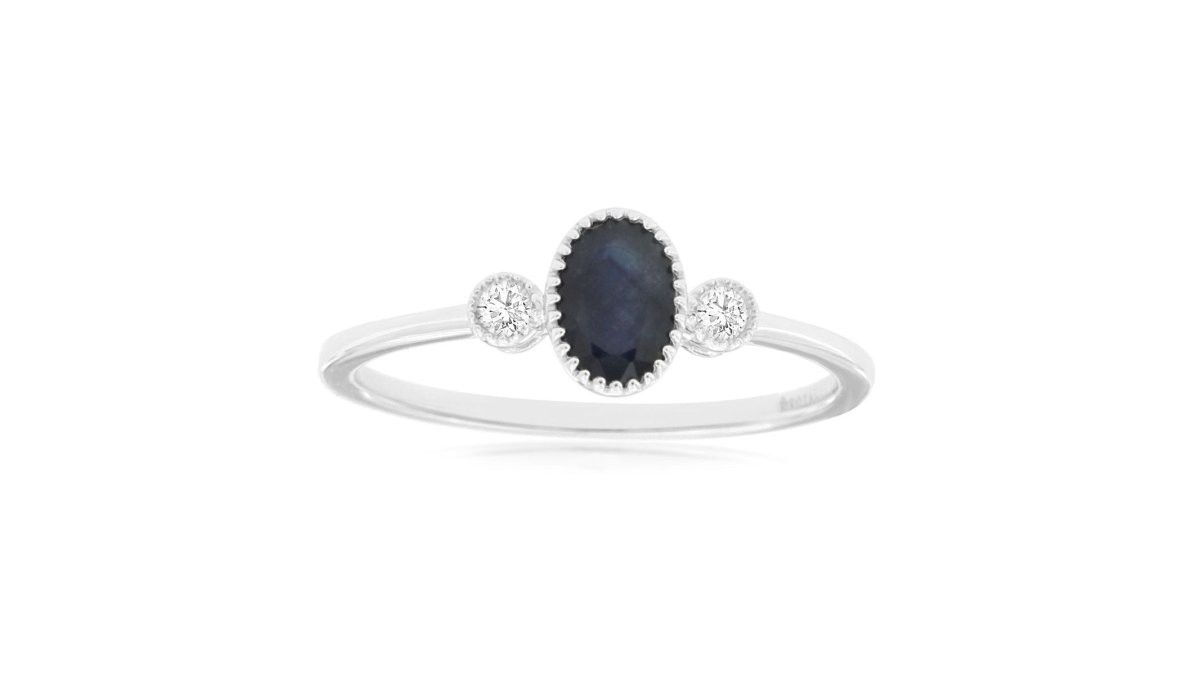
Sapphires bring color and prestige. A quality blue sapphire center stone with diamond accents feels luxurious and distinctive, and sapphires rank 9 on the Mohs scale, nearly as durable as diamonds.

Other gemstones, emeralds, rubies, aquamarines, offer personality and meaning. The trade-off is durability. Emeralds and aquamarines are more fragile than diamonds and require careful handling. If you love the look, the extra care is worth it.
The most satisfied customers chose the stone based on personal preference, not budget constraints. When you genuinely love moissanite's sparkle or a sapphire's color, the ring feels right.
The Custom Engagement Ring Design Process
Custom design doesn't automatically cost more than off-the-shelf. What changes is control: you decide every element, from stone size to metal type to setting style. The process unfolds in three phases.
Phase one is discovery. You articulate what matters: stone size, metal color, silhouette, classic or distinctive. Many people arrive uncertain, and that's normal, a good jeweler asks clarifying questions and explores options.
Phase two is design and approval. Your jeweler creates sketches or 3D renderings from multiple angles, so you can see proportions and request changes before any metal is cut or stone is set.
Phase three is fabrication. Metal is cast or hand-forged, stones are set, and the piece is finished and polished. At Eklektic, this happens entirely in our studio, from initial sketch through final polish, not in a factory overseas.
The investment in time creates something genuinely yours, not a mass-produced ring that happens to match your specifications.
How to Choose a Durable Engagement Ring Setting
The setting, the metal framework holding your stone, matters more than most buyers realize. It determines how secure your stone stays, how comfortable the ring feels, and how much maintenance it needs over decades. It's the part most budget-focused articles skip, and the part that decides whether a ring still looks right in year ten.
Setting style affects durability and aesthetics. A solitaire showcases one stone with minimal metal, elegant and timeless, but less protective. A halo surrounds the center stone with smaller stones for visual impact and extra security. Three-stone settings distribute weight across multiple stones. Pavé sets small stones closely along the band for continuous sparkle.

The maintenance reality nobody mentions
A lower-cost ring isn't fragile, but the choices that keep it affordable often shift more work onto you over time:
- Prong tightening. Thin, high-set prongs bend and loosen with daily wear; have a jeweler check them every six to twelve months. A loose prong is how stones get lost, and replacing a center stone usually costs more than the original setting.
- Rhodium replating. White gold is rhodium-plated for a bright white look. That plating wears through in one to two years of daily wear, exposing a faintly yellow tone. Replating is routine and recurring; platinum and yellow gold don't have this problem.
- Pavé and channel stones. Small stones in a shared channel or bead-set pavé can work loose individually. Each is a small repair, and on a delicate band they add up. A plain or solitaire band has almost nothing to fail.
- Soft metal wear. Sterling silver and 10k gold wear faster at contact points, thinning a band over years. A slightly thicker band is more durable than a thin one at the same price.
The setting should also suit your hands and daily activities. A high-set stone catches on clothing, gloves, and hair; a lower profile sits closer to the finger and takes far more abuse. Neither is wrong, it depends on your lifestyle and how much maintenance you'll accept.
Sentimental Value vs. Resale Value
Here's the tension most buyers don't discuss: the ring you love to wear and the ring that holds financial value are often different things.
Why resale value is brutal, mechanically
A ring purchased for $1,000 typically resells for a fraction of that, and the reason is structural, not a knock on your taste. Three forces work against you:
- The retail markup disappears instantly. Once a ring leaves the case, the buyer's premium, showroom overhead, and brand margin are gone. A resale buyer pays for metal and stone, not the buying experience.
- Diamonds have thin secondary liquidity. There's no efficient public exchange for a single used stone, and a dealer who buys it must resell it, so they build in a wide margin. Lab-grown diamonds have almost no resale market, since new ones are inexpensive and identical.
- Custom means one buyer. A ring designed for one person's taste, size, and stone preference has a market of exactly one. A classic solitaire in a standard size has a slightly larger pool, but it's still small.
This matters only if you might sell later. For most people, an engagement ring isn't an investment, it's a symbol worn daily. From that perspective, resale value is irrelevant, and treating the ring as an asset is the wrong frame entirely.
The social stigma factor
This is the part almost no article addresses, and it's often the real reason someone types "is a $1,000 ring cheap" at midnight.
The anxiety is rarely about the ring, it's about what the ring signals. A persistent cultural script ties the ring's price to the depth of commitment, and that script is loud on social media, in family conversations, and in reactions to the box. A buyer secure in the relationship can still feel exposed by the number.
A few things worth naming honestly:
- The three-months'-salary rule is a marketing artifact, not a deep-rooted tradition. It was popularized by a mid-century ad campaign and has no basis in how couples actually build lives together.
- Comparison is the thief of joy. The ring someone else wears was chosen for a different person, budget, and set of priorities. It tells you nothing about yours.
- The feeling fades. Within a year, most couples say the ring is simply part of the hand. What lasts is the decision, not the receipt.
What actually holds value
If resale genuinely matters, the levers are specific: classic solitaire or three-stone designs, standard ring sizes, high-clarity natural diamonds, and precious metals like platinum or 14k gold. Those keep the widest pool of future buyers. Everything else, custom engraving, unusual stones, personal silhouettes, trades resale value for meaning.
That trade is usually the right one. A ring you designed yourself, reflecting your taste and your partner's preferences, made by hand in a studio you visited, carries weight a mass-produced ring can't. Years from now, you'll remember designing it and the craftspeople who built it. Sentimental value outlasts any market price.
Lab-Grown Diamonds and Gemstone Quality at This Price Point
Lab-grown diamonds have erased the quality gap between natural and lab-created stones. At $1000, a lab-grown diamond offers better value per carat than a natural diamond of equivalent quality. Optical properties and durability are identical; the only difference is origin.
For engagement rings, this matters less than it once did. Lab-grown diamonds are widely accepted and the stigma has largely disappeared.
Quality metrics apply equally to both.
For gemstones like sapphires, quality assessment is more subjective. Color saturation matters tremendously, a vivid blue sapphire costs more than a pale one. Clarity matters less than with diamonds; slight inclusions are normal and don't significantly affect beauty or durability.
At this price point, you're not choosing between premium and budget, you're choosing between different types of beauty: a diamond's sparkle, moissanite's fire, a sapphire's color. Each is genuinely beautiful. The choice is personal.
Is $1000 Enough? Making the Decision
It depends on your priorities. A half-carat natural diamond with excellent cut and clarity is tight but possible at $1000. A full-carat lab-grown diamond with a custom setting works beautifully.
The real question is whether you're buying on external benchmarks or internal values. Many feel pressure to spend a certain amount because of tradition or social expectations, pressure worth examining.
Consider practical factors: Will you wear it daily? Does durability matter more than size? Classic or distinctive? Is the stone primary, or the setting equally important? Your answers determine whether $1000 is enough.
If you're uncertain whether $1000 is right, the best approach is a consultation. Talk to a jeweler who can show options, explain what different price points buy, and help you understand your priorities.
Choosing an engagement ring at any price point is ultimately about clarity: knowing what matters, understanding what you're purchasing, and feeling confident in the decision. At Eklektic, we specialize in helping you find that clarity through custom design and expert guidance. Book an appointment with our team to explore what $1000 can create.
Frequently Asked Questions
What size diamond can I get for $1000?
A $1000 budget typically yields a lab-grown diamond between 1.0-1.5 carats, depending on clarity and cut grade. Natural diamonds at this price point are usually smaller, 0.5-0.8 carats, because of market pricing. Lab-grown diamonds offer better value per carat, making them ideal if size matters more than origin. Clarity and cut quality will affect the final appearance more than carat weight alone.
Are alternative gemstones a good way to save on engagement rings?
Yes. Sapphires, moissanite, and other gemstones cost significantly less than diamonds while offering excellent durability and beauty. A 1.5-carat sapphire or moissanite ring fits comfortably within a $1000 budget. These alternatives also allow for more creative, personalized designs. The key is choosing stones with hardness ratings (9 or higher on the Mohs scale) to ensure long-term wearability as an everyday ring.
What matters most when choosing an engagement ring on a $1000 budget?
Prioritize setting durability and stone hardness over carat weight. A well-crafted setting in 14k gold, platinum, or sterling silver will protect your stone and last for generations. Choose gemstones rated 9+ on the Mohs hardness scale. Consider lab-grown diamonds or alternatives like sapphire for better value. Custom design lets you maximize visual impact within budget by focusing on cut quality and setting style rather than raw carat weight.
Is $1000 too little for an engagement ring?
No. A $1000 budget is reasonable and reflects a thoughtful investment. What matters is the quality of craftsmanship, durability of materials, and personal meaning, not the price tag. Many couples choose $1000 rings and wear them proudly for decades. The question isn't whether $1000 is 'enough,' but whether the ring you choose is well-made, suits your lifestyle, and holds meaning for you.