

Table of Contents
- Set Your Ring Budget and Prioritize Spending
- Engagement Ring Center Stone Options and Trade-Offs
- The Custom Engagement Ring Design Process on a Budget
- Questions to Ask a Custom Jeweler Before You Commit
- Smart Design Choices That Save Money Without Sacrificing Style
- Evaluating Your Custom Design Quote
- Frequently Asked Questions
Last Updated: October 5, 2026
Set Your Ring Budget and Prioritize Spending
The first step in setting your custom engagement ring budget is getting honest about what you can realistically spend.
Look at your actual available funds. Don't stretch yourself thin to hit an arbitrary number based on outdated "rules."
Once you know your total budget, break it into categories. A typical custom ring involves several cost components:
- Center stone (40-60% of total budget)
- Metal and setting (20-30%)
- Design work and labor (10-20%)
A studio like Eklektic will walk you through these costs transparently.
Your budget doesn't determine quality, it determines where you make trade-offs.
Engagement Ring Center Stone Options and Trade-Offs
Your center stone is typically the largest expense, so this is where smart choices create the biggest savings. You have three main paths forward: lab-grown diamonds, natural diamonds, or alternative gemstones.
Lab-Grown Diamonds vs. Natural Diamonds
Lab-grown diamonds cost significantly less than natural diamonds of comparable size and quality.
The trade-off is purely about origin: lab-grown diamonds are chemically identical to natural diamonds, graded by the same standards, equally durable, and visually indistinguishable.
At Eklektic, we stock lab-grown options like the LG Diamond - 2.12ct Pear and LG Diamond - 2.10ct Round, serious carat weight and excellent color grades at prices that leave room for other design elements.


Alternative Gemstones for Significant Savings
To stretch your budget further, consider a colored gemstone as your center stone. Sapphires, moissanite, and other alternatives cost a fraction of diamonds and offer unique appeal.
A lab-grown blue sapphire, like the Emerald Cut Lab Grown Blue Sapphire - 4.30ct, delivers stunning visual impact at a much lower price point than a diamond of similar size.

The practical consideration: alternative gemstones may be softer than diamonds. They're fine for daily wear if you're mindful, but they require slightly more care.
The 4Cs and Where to Compromise
The diamond industry grades stones on four factors: carat weight, cut, color, and clarity.
Carat weight is visible. People notice size. If carat matters to you, prioritize it.
Cut affects sparkle.
The budget move: invest in carat and cut quality. Accept good (not perfect) color and clarity grades.
The Custom Engagement Ring Design Process on a Budget
A custom ring is built in stages, and each stage is a checkpoint where changes are still cheap. The biggest budget risk is approving something too early and paying to undo it later.
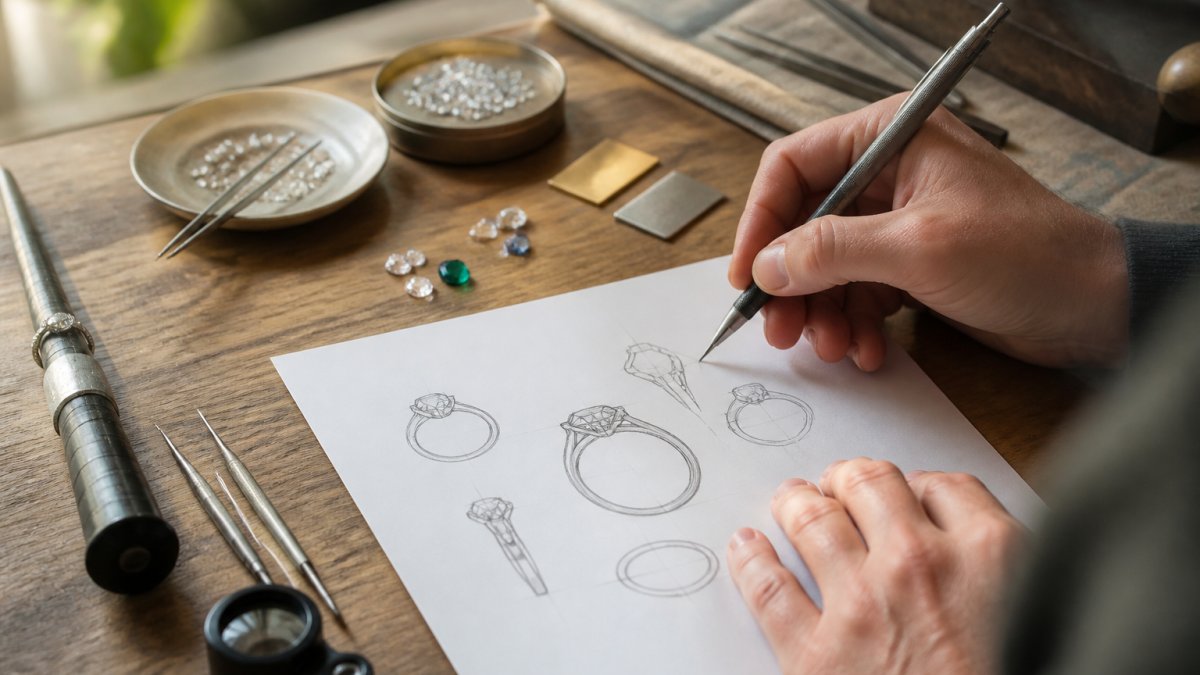
Stage 1: Inspiration and Style Brief
Before any drawing happens, collect reference images and write a short brief covering setting style, metal color and type, approximate center-stone shape and size range, and overall vibe.
This stage is free and saves the most money, every ambiguity you resolve now is a revision you don't pay for later.
Stage 2: Hand Sketch or Concept
Most jewelers start with a rough sketch or a few concept directions. This low-cost stage, often included in the design fee, is the right time to react strongly. Sketches are cheap to redo; metal is not.
Stage 3: CAD Render (the most important approval)
Computer-aided design produces a 3D model you can view from every angle. This checkpoint determines your final cost: once the CAD is approved and cast, changes become expensive.
Review the CAD for:
- Proportions, band width relative to the center stone, and how high the stone sits above the finger
- Prong count and thickness, fewer, thinner prongs cost less but change the look and the security
- Accent stone placement, how many, what size, and how they sit against the center stone
Ask for the render as a zoomable file with marked dimensions. Buyers often approve a CAD that looks balanced on screen but reads as too tall or too thin in person.
Stage 4: Wax or Resin Model (optional but valuable)
Some jewelers print a wax or resin model of the approved CAD so you can hold a physical version. It isn't the final metal, but it lets you feel the weight and scale on a hand, catching proportion problems before casting.
Stage 5: Casting, Stone Setting, and Finishing
Once the model is approved, the ring is cast, the stones are set, and the piece is polished. Changes after this point are the most expensive, sometimes requiring the ring to be cut, re-cast, or re-set. Confirm in writing what happens if the finished ring doesn't match the approved CAD.
Stage 6: Final Inspection and Delivery
Before accepting the ring, inspect it under a loupe: confirm the center stone matches the agreed specs and grading document, prongs are even and secure, accent stones are tight, and the polish is clean inside the band.
The budget rule for the whole process
Spend your decision-making energy early: sketches and CAD renders are where changes are cheap, casting and setting are not. A buyer who locks the design at the CAD stage almost always finishes closer to budget.
Questions to Ask a Custom Jeweler Before You Commit
Before you commit to a custom engagement ring budget, ask these questions. The answers reveal how transparent a jeweler really is.
On pricing and costs:
- What's included in your quoted price?
- Are there any additional fees I should expect (design revisions, rush fees, finishing)?
- What's your payment schedule (deposit, balance, final payment)?
On the design and production process:
- How many design revisions are included?
- When will I see the 3D rendering?
- What's the typical timeline from approval to completion?
On materials and quality:
- Can you provide documentation for the center stone (grading report, certification)?
- What metal purity are you using (14K, 18K, platinum)?
- Do you offer any warranty or guarantee on the finished ring?
On communication and changes:
- How will we stay in touch during production?
- What happens if I want to make changes after approval?
- What's your policy if I'm not satisfied with the finished ring?
A jeweler who answers these directly is someone you can trust. Vague answers or reluctance to discuss costs are red flags.
Smart Design Choices That Save Money Without Sacrificing Style
You don't have to compromise on beauty to stay within budget. Strategic design choices deliver visual impact at lower cost.
Metal Selection and Weight Optimization
Platinum is beautiful but expensive.
Choose the metal you genuinely prefer, not the most expensive option, a beautifully designed white gold ring will always outshine a poorly designed platinum one.
Metal weight matters too. A skilled designer uses just enough metal for durability without wasting material, keeping costs down while maintaining structural integrity.
Setting Design Complexity
Intricate settings with multiple accent stones cost more to design and fabricate.
That doesn't mean boring, a well-proportioned solitaire in quality metal with excellent polish is elegant and timeless.
Three-stone or halo designs add visual interest without extreme complexity, more presence than a solitaire at less cost than highly ornate designs.
Sizing and Proportions That Maximize Visual Impact
Ring proportions matter more than most people realize. A well-proportioned setting makes a stone look larger and more brilliant.
Work with your jeweler on these details:
- Band width relative to stone size (too thin looks fragile, too thick overwhelms)
- Stone height above the band (affects both aesthetics and wearability)
- Setting profile (low and sleek vs. tall and dramatic)
These choices don't cost more, they create visual impact through proportion rather than material expense.
Evaluating Your Custom Design Quote
A custom quote is only useful if you can compare it to another and see what's included. Two quotes for the "same" ring can differ by hundreds or thousands of dollars because one bundles design work, certification, and sizing while the other charges separately.
What a complete quote should itemize
| Line item | What to confirm |
|---|---|
| Center stone | Shape, carat weight, color grade, clarity grade, and whether a grading report is included |
| Accent stones | Quantity, total carat weight, and quality grade |
| Metal | Type (e.g., 14K or 18K white gold, yellow gold, rose gold, platinum) and estimated weight |
| Design and CAD work | Number of sketch and CAD revisions included |
| Labor and fabrication | Casting, stone setting, and finishing |
| Sizing and final finish | Whether the initial size is set at no extra cost |
| Taxes, shipping, insurance | Whether these are in the total or added later |
| Total | One number that reflects everything above |
If a quote collapses all of this into a single figure, ask for the breakdown. A jeweler who won't itemize can't be compared against anyone else.
How to compare two quotes like-for-like
Put both quotes side by side and check five things:
- Same stone specs? A quote with a lower color or clarity grade is not cheaper, it is a different stone. Match carat, cut, color, and clarity before comparing price.
- Same metal and purity? 14K and 18K gold are not interchangeable, and platinum is a different material entirely. Confirm the metal and the purity match.
- Same revision allowance? One quote may include two CAD revisions; another may charge per revision. Estimate how many you will realistically need.
- Same certification? A quote that includes an independent grading report is not the same as one that does not. Ask who pays for the report.
- Same inclusions? Sizing, shipping, insurance, and taxes are the most common items that appear in one quote and not the other.
Verify the stone grading documentation
For a diamond center stone, ask for the grading report and confirm it matches the stone in the quote.
Check that the report number matches the actual center stone, not a similar stone from the same parcel. If the jeweler can't produce a report, treat the stated grades as unverified.
Fees and terms to confirm in writing before you commit
- Design or CAD fee, is it a flat fee, hourly, or credited toward the final price if you proceed?
- Revision fees, how many rounds are included, and what each additional round costs
- Rush fees, what the standard timeline is and what faster production adds
Red flags in a custom quote
- A single lump-sum price with no breakdown
- Stated stone grades with no supporting documentation
- Vague or verbal-only answers about revisions, timelines, or deposits
A trustworthy quote is specific, itemized, and willing to put terms in writing. If you have to chase the details, that tells you how the rest of the project will go.
Frequently Asked Questions
Is it cheaper to design your own custom engagement ring?
Yes, designing a custom engagement ring typically costs less than buying from a mass-market retailer. You control every element and can prioritize spending on what matters most to you. By choosing a lab-grown diamond or alternative gemstone, simplifying the setting design, and making intentional trade-offs on the 4Cs, you can create a beautiful ring well within your budget.
Which design choices have the biggest effect on a custom engagement ring's cost?
The center stone accounts for a significant portion of the total cost. Choosing a lab-grown diamond over a natural one, or selecting an alternative gemstone like sapphire, can offer savings. Metal choice matters too. Setting complexity, additional accent stones, and hand-finishing details add to the price, but these are easier to adjust. Focus your budget decisions on the stone first, then the metal, then the setting style.
What should I ask a custom jeweler before starting a custom engagement ring design?
Ask about their design process, timeline, and revision policy. Request a detailed, itemized quote that breaks down stone cost, metal weight, labor, and any finishing fees. Confirm whether modifications after the initial design are included or cost extra. Ask how they source stones and whether they offer lab-grown or alternative options. Understand their approval process: do you get a 3D rendering to review before production begins? Ask about their experience with budget-conscious designs and what cost-saving options they typically recommend.
Can I use a lab-grown diamond or alternative gemstone in a custom engagement ring?
Absolutely. Lab-grown diamonds are chemically identical to natural diamonds and cost 30-40% less. Sapphires, including lab-grown varieties, offer beautiful color and excellent durability. Many custom jewelers stock these options and can set them in any design you want. Lab-grown stones like the LG Diamond options available through specialized jewelers provide certified quality at a fraction of natural diamond pricing, making them ideal for budget-conscious custom designs.