

Table of Contents
- Custom Jewelry Design vs Store-Bought: A Side-by-Side Comparison
- Uniqueness and Personalization: Why One-of-a-Kind Matters
- The Custom Engagement Ring Design Process Explained
- How Long Does Custom Jewelry Take vs Ready-Made Options
- Cost Breakdown: Custom vs Store-Bought Jewelry
- Custom Jewelry Consultation Questions to Ask Before You Commit
- Custom Jewelry Design Ideas and When to Choose Them
- Pros and Cons of Custom Jewelry Design
- Frequently Asked Questions
Last Updated: October 17, 2026
Custom Jewelry Design vs Store-Bought: A Side-by-Side Comparison
When you're shopping for jewelry that matters, an engagement ring, an anniversary piece, or an heirloom, the choice in custom jewelry design vs store-bought options shapes everything that follows. At Eklektic, we help clients face this decision daily, and the answer isn't always obvious. Both paths have real advantages; the question is which aligns with what you want.
Custom jewelry design offers something store-bought pieces cannot: a piece designed from scratch to match your vision, budget, and story. Store-bought jewelry offers speed, predictability, and the ability to walk out with something beautiful today. Neither is inherently better, what matters is understanding the trade-offs.
Key Differences at a Glance
| Aspect | Custom Jewelry Design | Store-Bought Jewelry |
|---|---|---|
| Uniqueness | One-of-a-kind, completely personalized | Mass-produced or limited editions |
| Timeline | 4-8 weeks typical | Available immediately |
| Design Input | You collaborate with a designer | Pre-designed by manufacturer |
| Flexibility | Full creative control | Limited customization options |
| Price Range | Varies widely based on your specifications | Set retail price |
| Quality Control | Direct oversight of fabrication | Manufacturer's standards |
| Revisions | Can modify design before final production | Limited or no changes |
Uniqueness and Personalization: Why One-of-a-Kind Matters
Here's what makes custom jewelry design different: you're not choosing from what exists. You're creating what will exist.
When you work with a jewelry designer, you describe your vision, the metal you love, the stones that speak to you, the proportions that feel right on your hand, and a designer like those at Eklektic translates it into reality.
Store-bought jewelry, even when beautiful and well-made, is designed for a general audience. The proportions, metal weight, and stone size are choices someone else made, betting on broad appeal. If that matches what you want, excellent, but if you're particular or have specific requirements, store-bought options often feel like compromises.
One practical advantage of custom design: you can choose exactly which stones go into your piece. If you have a family heirloom stone you want to reset, or if you've sourced an unusual gemstone you love, a custom designer can build the setting around it. That's not typically an option with store-bought jewelry.
The Custom Engagement Ring Design Process Explained
The custom engagement ring design process typically unfolds in distinct stages, and understanding the workflow helps you know what to expect.
It starts with a consultation, in person or virtually, a conversation, not a sales pitch.
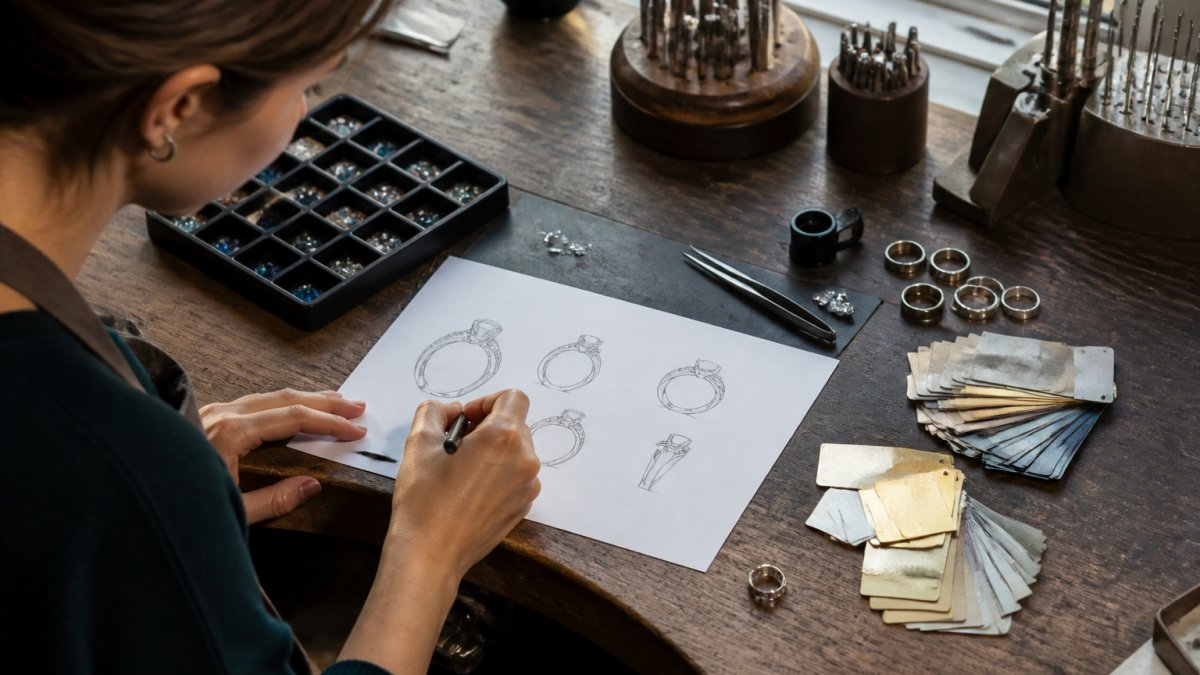
After the consultation, the designer creates sketches or digital renderings. You see the proportions, metal choice, and how the stone sits in the setting, and you can request changes, a wider band, a different stone size or metal.
Fabrication is where craftsmanship matters most. A skilled jeweler hand-fabricates your ring or uses CAD to create a precise model before casting, with careful stone setting, meticulous finishing, and quality control at every step.
How Long Does Custom Jewelry Take vs Ready-Made Options
Timeline is often the biggest practical difference between custom and store-bought jewelry.
Store-bought jewelry is ready now: visit a retailer, see the piece, buy it, and walk out the door. Online orders ship within days. If you need jewelry for an event next week, store-bought is your only realistic option.
Custom jewelry takes longer, but not as long as many assume: typically 4-8 weeks from consultation to finished piece. Simpler designs move faster; complex pieces with intricate details or multiple revisions take longer.
If you're planning ahead, which most people are for engagement rings or major anniversary pieces, the timeline is rarely a dealbreaker. You're not waiting months. You're waiting weeks. That wait time is when the designer is actually crafting your piece, not mass-producing something that was already made.
Store-bought jewelry is already made, so there's no fabrication wait, but modifications like resizing or changing the stone or metal mean waiting again, often at additional cost.
Cost Breakdown: Custom vs Store-Bought Jewelry
Cost is where the comparison gets nuanced, because "custom jewelry" and "store-bought jewelry" don't have fixed price ranges. Both can be affordable or expensive depending on what you choose.
Custom jewelry costs what your design costs to make. A complex design with premium stones and hand-finishing costs more, but you get something no one else owns.
Store-bought jewelry carries retail markup, you pay for the brand, the retailer's overhead, marketing, and profit margins.
The real cost advantage of custom jewelry is control: you decide how much to spend, and the designer works within your budget. You're not paying for unwanted features or brand prestige, only for exactly what you're getting.
At Eklektic, custom pieces range widely based on materials and complexity. A handmade sterling silver ring might start around $785, while a custom gold pendant with diamonds could range into the thousands depending on specifications. The point is: you're not locked into a price tier. You define the budget, and the designer creates within it.

Custom Jewelry Consultation Questions to Ask Before You Commit
Before starting the design process, ask the right questions to understand what you're getting into and whether custom design is right for you.
About the Designer and Process:
- Do you fabricate the jewelry in-house, or do you outsource? (At Eklektic, we do much of the work right here in our studio, from design through casting, setting, and finishing.)
- How many design revisions are included before final production?
- What happens if I hate the finished piece?
- Can I see examples of your previous work?
About Your Specific Project:
- If I have a stone I want to use, can you build a setting around it?
- What metals do you work with? (Eklektic works with gold, platinum, and sterling silver.)
- How do you handle complex requests or unusual materials?
- If I change my mind during the design phase, what are the costs?
About Timeline and Communication:
- What's the typical timeline from consultation to finished piece?
- How often will we communicate during the design and fabrication process?
- What happens if I need the piece faster than your standard timeline?
About Cost:
14ky Handmade Diamond Bracelet →
- How do you price custom work? (By hourly labor? By materials plus a design fee? A flat rate?)
- Are there additional costs I should expect beyond the quoted price?
- Do you offer payment plans or deposit structures?
These questions separate designers who are genuinely interested in your vision from those just taking orders.
Custom Jewelry Design Ideas and When to Choose Them
Custom design shines in specific scenarios. Knowing when custom makes sense helps you make the right choice.
Redesign of inherited jewelry: If you have a family heirloom, a grandmother's engagement ring, a vintage brooch, a gold necklace, you wouldn't wear as-is, custom redesign is perfect.
Statement pieces and collectibles: If you're building a fine jewelry collection, custom pieces are often more interesting and unique than mass-produced alternatives, each telling a story and reflecting your taste.
Pieces with personal meaning: You want to incorporate something personal, a stone from a meaningful location, a design referencing an important moment, or materials that hold significance.
When you have unusual requirements: Maybe you need extra-durable settings for active wear, specific alloys for metal sensitivities, or ethically sourced stones. Custom designers can accommodate these needs.
Store-bought jewelry makes sense when you want something beautiful today, you're not particular about uniqueness, or you like a piece you see and want to buy it immediately.
Pros and Cons of Custom Jewelry Design
Custom Jewelry Pros
Complete personalization. You're not compromising, the piece is designed specifically for you, reflecting your taste and vision. This matters most for pieces you'll wear often or pass down.
Control over materials and quality. You know exactly what goes into your jewelry, the metal, the stones, the quality standards. No guessing about what you're getting.
Often better value. Buying directly from a maker without retail markup means custom jewelry can cost less than comparable store-bought pieces, especially for engagement rings and fine jewelry.
Ability to use existing stones. If you have a family heirloom stone or a gemstone you've sourced, a custom designer can build a setting around it.
Revisions during design phase. Before anything is fabricated, you can adjust the design. Want the band wider? The stone larger? The metal different? You can make these changes without starting over.
Custom Jewelry Cons
Longer timeline. Custom jewelry takes 4-8 weeks from consultation to finished piece. If you need something immediately, this doesn't work.
Requires clear communication. You need to articulate your vision well enough for a designer to execute it. If you're unclear about what you want, the process can be frustrating.
Upfront commitment. You're typically paying a deposit before work begins. If you change your mind, you might lose that deposit. This requires confidence in your choice.
Dependency on designer quality. Your finished piece is only as good as the designer and craftsperson executing it. If you choose a designer without strong work or good communication, you could end up disappointed.
Limited ability to see the finished piece before committing. You're approving a design rendering, not the actual piece. There's always some uncertainty until the finished jewelry arrives.
Potential for misalignment between vision and execution. Even with clear communication, sometimes the finished piece doesn't feel exactly as you imagined. This is rare with skilled designers, but it happens.
Choosing between custom jewelry design and store-bought jewelry comes down to what you value most: uniqueness and personalization, or speed and simplicity. Whether you're creating an engagement ring from scratch, redesigning inherited jewelry, or commissioning a one-of-a-kind piece, we take time to understand your vision and turn it into jewelry you'll love wearing for years to come. Book an appointment to discuss your custom jewelry project and see how we can bring your vision to life.
Frequently Asked Questions
What are the main benefits of custom jewelry design?
Custom jewelry design offers uniqueness, personalization, and the ability to create exactly what you envision. You control every detail, metal type, stone selection, size, and style, resulting in a one-of-a-kind piece. Custom pieces often become family heirlooms and hold greater sentimental value. You also work directly with artisans who understand your vision and can solve design challenges that off-the-shelf pieces cannot address.
Is custom jewelry more expensive than store-bought options?
Custom jewelry can range widely in price depending on complexity, materials, and craftsmanship. Simple custom pieces may cost less than high-end store-bought jewelry, while intricate designs with premium stones cost more. The key difference is that custom jewelry is priced based on the specific materials and labor involved in your unique piece, whereas store-bought jewelry includes retail markup. Many people find custom jewelry offers good value because you're paying for exactly what you want, not factory inventory.
How long does custom jewelry take to create?
Custom jewelry typically takes 4-8 weeks depending on design complexity, material availability, and the jeweler's schedule. Simple designs may be completed in 4-6 weeks, while intricate pieces with multiple stones or special metalwork can take longer. The custom jewelry design process itself, from initial consultation through sketches and approvals, usually takes 1-3 weeks before fabrication begins. Reputable studios provide a timeline upfront so you know exactly when to expect your finished piece.
What questions should I ask during a custom jewelry consultation?
Ask about the design process, timeline, and total cost including materials and labor. Inquire about revisions and whether changes incur extra fees. Request to see examples of previous work and understand the jeweler's experience with your specific style. Ask about payment terms, whether deposits are required, and what happens if you're unsatisfied with the design. Also ask about aftercare, warranty, and whether the jeweler can resize or repair the piece in the future.
Can I customize an existing jewelry design instead of starting from scratch?
Yes, many jewelers offer customization of existing designs. You can modify store-bought pieces, redesign inherited jewelry, or adapt a design you've seen elsewhere. This approach often costs less than a fully custom design because the foundation already exists. You might change the stone, adjust sizing, alter metal type, or add personal elements. This is an excellent option if you love a particular style but want to personalize it or if you're redesigning sentimental pieces from family members.