

Table of Contents
- Cost of Custom Engagement Ring vs Retail Store: The Core Difference
- What Drives Custom Engagement Ring Cost: A Full Breakdown
- The Custom Ring Design Process: Where Labor and Fees Come From
- Custom Engagement Ring Timeline: How Long It Takes and What It Costs
- How to Compare Engagement Ring Quotes Side by Side
- Total Ownership Costs: What Happens After You Buy
- Which Route Fits Your Budget and Priorities?
- Frequently Asked Questions
Last Updated: October 9, 2026
Cost of Custom Engagement Ring vs Retail Store: The Core Difference
The cost of a custom engagement ring versus a retail store purchase comes down to where the money goes. A retail store price bundles the stone, the setting, the brand name, and the showroom overhead into one tag.
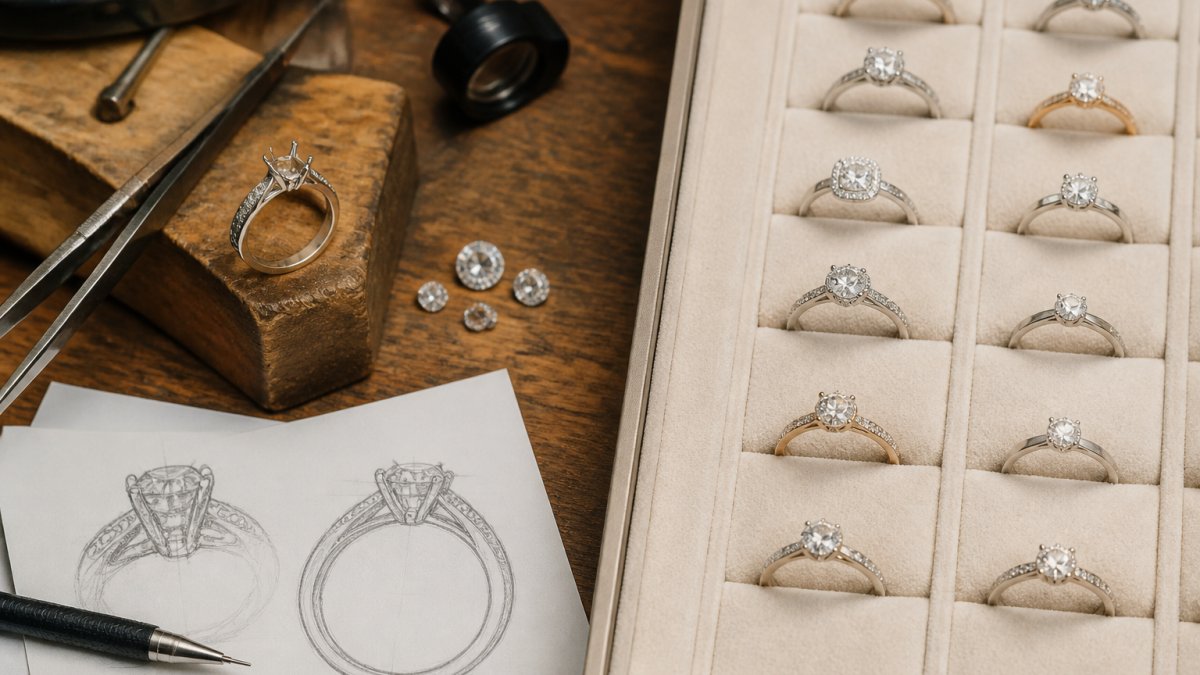
How Retail Store Pricing Works
A retail store price is a package deal. The ring you see already exists, so its cost was set months ago when the store bought inventory.
Retail pricing also moves slowly. A store cannot re-price a case of rings every time diamond costs shift, so the markup absorbs the difference.
The upside is speed. You walk in, you walk out with a ring.
How Custom Pricing Works
Custom pricing is quoted, not tagged. You choose the center stone, the metal, and the design, and the quote reflects those choices. Nothing is bundled.
That transparency cuts both ways. You see what a larger stone adds, and you see what a simpler setting saves. You also carry the cost of design time, which a retail tag hides inside the markup.
What Drives Custom Engagement Ring Cost: A Full Breakdown
Four things move a custom quote: the center stone, the metal, the setting, and the design complexity. Change any one and the total shifts.
Center Stone: Type, Size, and Quality
The center stone is usually the largest line item. Lab-grown diamonds cost less than natural diamonds of the same size and grade, which is the single fastest way to free up budget for metal or design work. Cut matters more than carat for how a stone looks, and clarity and color grades above "eye-clean" add cost you may never see.
Metal Choice and Setting Materials
Platinum costs more than 14k or 18k gold per gram and weighs more, so the same design in platinum runs higher. Gold offers more color options and a lower entry point. The setting style matters too: a halo uses more small diamonds than a solitaire, and a hand-finished band takes more bench time than a cast one.
| Cost Driver | What Raises the Price | Where You Can Save |
|---|---|---|
| Center stone | Larger carat, higher clarity, natural origin | Lab-grown stone, eye-clean grade |
| Metal | Platinum, 18k gold, heavier band | 14k gold, slimmer band |
| Setting | Halo, pavé, hand-finished details | Solitaire, simple shoulders |
| Design | Fully bespoke, multiple revisions | Adapting an existing design |
The Custom Ring Design Process: Where Labor and Fees Come From
Design and labor are the costs retail shoppers never see itemized. A custom ring moves through consultation, sketches, a CAD model, casting, stone setting, and finishing. Each stage consumes bench time from a skilled jeweler, and that time is the fee. Understanding how studios structure that fee is what separates a quote you can compare from one you cannot.
How Design Fees Are Typically Structured
Most custom studios use one of three models, and the model matters more than the headline number:
- Flat design fee. A single charge covers consultation, sketches, and the CAD model, regardless of how many rounds you use. Predictable, but you may pay for revisions you never need.
- Hourly or stage-based fee. You are billed for consultation time, CAD time, and bench time separately. Transparent, but the total is unknown until the work is done.
- Credited design fee. The design fee is applied toward the final ring if you proceed. This is common when the studio wants to discourage clients from taking a CAD file to a competing shop.
Ask which model applies before you approve anything. A flat fee and an hourly fee can look identical in the first conversation and diverge sharply by the third revision.
What Triggers Additional Charges
Revision rounds add cost when they change structure, not surface. Swapping a center stone or adjusting band width is minor. Redrawing the entire setting after casting has started is not, which is why the CAD model is confirmed before anything is cut. The pattern most studios follow:
| Change | Typical Cost Impact |
|---|---|
| Stone swap before casting | Minor or none |
| Band width or profile adjustment | Minor |
| Setting redesign after CAD approval | Moderate, new CAD time |
| Structural change after casting begins | Significant, may require a new casting |
| Metal change after casting | Significant, new casting and finishing |
CAD, Wax, and Hand-Carved Models
A CAD model is a digital render you approve before production. A wax model is a physical carving you can hold and try on. Hand-carved models take the most bench time and cost the most, but they let a jeweler work details a CAD program renders poorly, such as organic textures or asymmetric settings. Most studios default to CAD because it is faster and cheaper to revise.
Ownership of the Design
One cost question shoppers rarely ask: who owns the CAD file after the ring is made? Some studios retain it and will not reproduce the design for anyone else, including you. Others release it. If you may want a matching band later, or a repair from a different jeweler, clarify this before you approve the model. It affects what you can do with the ring in year five, not just on delivery day.
Custom Engagement Ring Timeline: How Long It Takes and What It Costs
A custom engagement ring typically takes several weeks from approved design to finished piece. The stone sourcing and CAD stages carry the most variability, since a specific stone may need to be located and a design may need one or two revision rounds.
Timeline is a cost, even when no invoice line names it. Rush work compresses the schedule and often adds a premium. Starting early keeps you in the standard queue and avoids that charge.
14ky Blue Sapphire Abbey Ring →
| Stage | Typical Duration | Cost Impact |
|---|---|---|
| Consultation and sketches | A few days | Included in design fee |
| CAD model and revisions | One to two weeks | Extra rounds add cost |
| Stone sourcing | Days to weeks | Varies by stone rarity |
| Casting and setting | One to two weeks | Fixed by design |
| Finishing and sizing | A few days | Minor unless resizing |
How to Compare Engagement Ring Quotes Side by Side
Comparing quotes means comparing the same ring, not two different ones. Line up the stone's carat, cut, color, clarity, and certification, then the metal type and weight, then the setting style.
Ask every quote to state the stone grade, metal, setting, design fee, and whether sizing is included. A lower total with an uncertified stone is not a cheaper ring, it is a different one.
Total Ownership Costs: What Happens After You Buy
Purchase price is not the last cost. After the sale comes resizing, cleaning, inspection, and any repair from wear. Comparing ownership means comparing policies, not just tags.
The Aftercare Categories That Actually Cost Money
Most rings will need at least some of the following over their life:
- Resizing. Fingers change size with season, weight, and age. A plain band is straightforward to resize. A pavé or channel-set band is not, because the stones must be removed and reset. Ask whether sizing is included and for how long.
- Rhodium plating. White gold is rhodium-plated to look bright. The plating wears and needs reapplication periodically. Platinum does not need this, which is one reason its higher upfront cost can narrow over time.
- Prong tightening and inspection. A loose prong is the most common cause of a lost stone. Annual inspection is cheap; replacing a center stone is not.
How Warranty Terms Change Effective Value
A warranty is only worth what it covers. Read the policy for these specifics:
| Policy Question | Why It Matters |
|---|---|
| Does it cover loss of the center stone? | This is the single most expensive failure mode |
| Is inspection required to keep coverage? | Missed inspections can void the warranty |
| Who performs the work? | In-house service is faster; third-party service adds shipping |
| Does coverage transfer? | Matters if the ring is ever gifted or resold |
| What voids it? | Work by another jeweler often does |
A warranty that requires annual inspections you never schedule is worth less than a shorter warranty with no conditions. Read the terms, not the label.
Why Custom Studios Often Win on Service
Custom work has a structural advantage here: the studio that made the ring can service it. The CAD file, the metal alloy, and the setting method are all known, so a repair does not require reverse-engineering someone else's work. We handle repair, restoration, and stone replacement in-house, so a loose stone or a worn prong does not mean shipping the ring away.
Insurance and Replacement
Most homeowners or renters policies will schedule a ring as a rider, and a standalone jewelry policy is also common. Insurers typically want an appraisal or a receipt with the stone's grading report. This is where a certified stone pays off twice: it protects resale value and it makes insurance replacement straightforward. If the stone is uncertified, the insurer may only replace it with a comparable ungraded stone, which is rarely the same thing.
Which Route Fits Your Budget and Priorities?
Retail wins on speed and certainty. You see the finished ring, you know the price, and you leave with it. If you want a ring this month and a known total, that path is hard to beat.
Custom wins on control. You decide where the money goes, you choose the stone and the metal, and you get a piece no one else owns.
For couples weighing this, our 14kw Blue Sapphire and Diamond Ring shows how a genuine sapphire and diamond combination can anchor a custom design, and the 14kw LG Diamond Anniversary Ring demonstrates lab-grown stones in a bridal setting.


Frequently Asked Questions
Is a custom engagement ring more expensive than a store-bought ring?
It depends on the design and stones you choose. A custom ring often costs more upfront because you pay for design time, a one-off setting, and hand finishing. But you control every material decision, so you can shift budget toward the center stone and away from retail display-case markup. For a like-for-like diamond and metal, custom and retail pricing can land close together, with custom giving you a piece no one else owns.
How much does a custom engagement ring usually cost?
There is no single number because cost of a custom engagement ring depends on the center stone, metal, design complexity, and labor. A simpler design with a modest stone sits at the lower end, while a large certified diamond in platinum with intricate detailing pushes higher. The clearest way to budget is to set a total figure, then split it between stone and setting, and ask your jeweler to quote each part separately.
What should I compare when getting quotes for a custom engagement ring?
Ask every quote to list the same items: center stone type, carat weight, cut, color, clarity, and certification; metal type and weight; setting style; design and labor fees; timeline; and what aftercare is included. When quotes use the same format, differences become obvious. A quote that hides the design fee or stone grading is harder to compare and often costs more once extras are added.
How long does it take to make a custom engagement ring?
A custom engagement ring timeline typically runs several weeks from first sketch to finished piece. Design and CAD revisions take time, casting and stone setting add more, and finishing and quality checks come last. Rush timelines are sometimes possible but can add cost. If you have a proposal date in mind, start the process early and confirm each milestone in writing with your jeweler.
Does a custom engagement ring cost more for the same diamond?
The diamond itself costs roughly the same whether it goes into a custom or retail setting, since grading and sourcing set the stone price. The difference is in the setting and labor. Custom work adds design and fabrication fees, while retail bundles those into the display price. Comparing the stone and the setting separately shows where each route actually spends your money.
The hard part is not choosing custom or retail. It is finding a studio that shows you the CAD model, quotes the stone and the labor separately, and can still service the ring years later. Eklektic designs, casts, sets, and finishes every piece in our own studio, offers a three-day review period on online purchases, and handles repair and restoration in-house. Book an appointment with Eklektic and see your ring before it is made.