

Table of Contents
- Custom Engagement Ring Cost: Key Price Ranges to Expect
- Factors Affecting Engagement Ring Price
- The Custom Engagement Ring Design Process
- Build-Your-Own vs. Fully Bespoke: Two Paths, Two Budgets
- Timeline for Custom Engagement Rings
- Hidden Costs in Custom Jewelry: What the Quote Might Miss
- Resale Value, Insurance, and Ethical Sourcing: Costs Beyond the Purchase
- Frequently Asked Questions
Last Updated: September 23, 2026
Custom Engagement Ring Cost: Key Price Ranges to Expect
The short answer: there is no single price for a custom engagement ring, because the final figure is the sum of a center stone, a metal choice, a setting style, and the labor to build it. This guide from Eklektic breaks down each line item so you can build a realistic budget before you ever sit down with a jeweler.
Factors Affecting Engagement Ring Price
Four things decide what you pay: the center stone, the metal, the setting complexity, and the design labor behind the piece. Get these in the right order and the budget math becomes predictable.
Center Stone: The Single Biggest Cost Driver
The center stone is usually the largest single line on any quote. Size, cut quality, color, and clarity all move the price, and a stone that looks nearly identical to the eye can sit at a very different price point depending on those grades. This is why a reputable jeweler will walk you through stone sourcing before you fall in love with a specific look.
Metal Choice: Platinum vs Gold Pricing
The metal is the second-largest variable, and it's more than a color decision. Karat gold (10K, 14K, 18K) and platinum each carry different costs, weights, and wear characteristics. Higher karat gold contains more gold and costs more, while platinum is denser and typically priced higher per gram. Metal weight matters too: a heavier band uses more material and adds to the total.
Setting Complexity and Labor Fees
Setting complexity is where labor fees quietly add up. A simple solitaire uses minimal labor. Add side stones, a halo design, or pavé settings and the labor climbs fast, because each small stone must be set by hand. Design complexity, not just material, drives the final labor number.
| Cost Factor | What Moves the Price | Budget Impact |
|---|---|---|
| Center stone | Size, cut, color, clarity, sourcing | Largest single cost |
| Metal | Karat, platinum vs gold, metal weight | Second-largest cost |
| Setting | Solitaire vs halo, side stones, pavé | Moderate to high |
| Labor | Design complexity, hand-setting time | Variable |
The Custom Engagement Ring Design Process
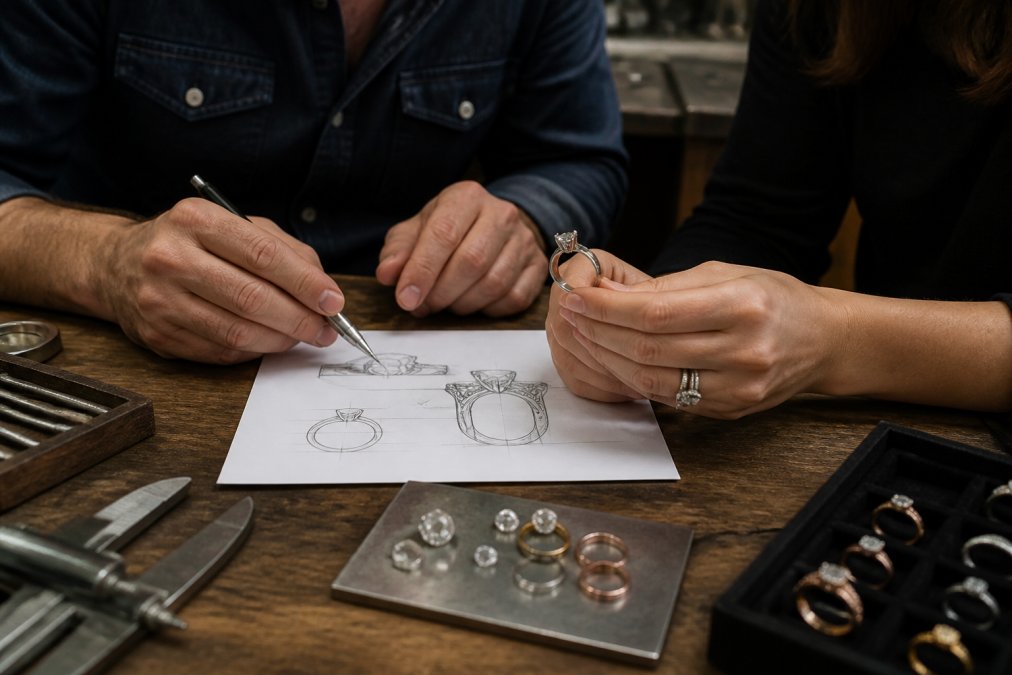
The custom engagement ring design process runs from first sketch to finished piece, and each stage carries its own fee or labor cost. Understanding the sequence helps you see where your money goes and where you can make trade-offs.
CAD Design and 3D Rendering Fees
CAD design is the computer-aided drafting stage where your idea becomes a precise digital model. A 3D rendering lets you see the ring before any metal is cut. Some studios charge a design fee or CAD fee upfront, and some credit it toward the final purchase if you move forward. Ask directly whether the CAD and rendering fee is refundable or applied to the build.
From Wax Model to Casting and Stone Setting
Once the design is approved, the piece moves to a wax model or custom mold, then to the casting process, and finally to stone setting and finishing. This is jewelry craftsmanship in its most hands-on form, and it's where a lot of the labor fee lives. A simple cast and set takes less time than a design with dozens of small stones.
Build-Your-Own vs. Fully Bespoke: Two Paths, Two Budgets
There are two routes, and they carry different budgets. Build-your-own starts from an existing setting and lets you choose the stone and metal. Fully bespoke starts from a blank page, with a custom design, CAD work, and a one-of-a-kind result. Build-your-own is faster and typically less expensive because the design labor is already done. Fully bespoke costs more because you're paying for original design time, a custom mold, and the craftsmanship of a piece that doesn't exist anywhere else.
Timeline for Custom Engagement Rings
The timeline for custom engagement rings depends on design complexity and stone sourcing, and it usually runs longer than a retail purchase. A build-your-own piece moves faster because the setting already exists. A fully bespoke ring adds design, CAD revisions, casting, and hand-setting time. If you're working toward a proposal date, start earlier than feels necessary and confirm the studio's realistic turnaround before you commit.
Hidden Costs in Custom Jewelry: What the Quote Might Miss
The quote you get isn't always the full picture. Several costs sit outside the headline number, and knowing them upfront keeps you from surprises.
- Design or CAD fees that aren't credited toward the purchase
- Ring sizing after the fact, especially on a finished piece
- Appraisal fees for insurance documentation
- Sales tax and shipping on the finished ring
- Rush fees for a compressed timeline
- Modification charges if you want changes after delivery
| Hidden Cost | Why It Appears | How to Plan |
|---|---|---|
| Design/CAD fee | Original drafting time | Ask if it's credited |
| Resizing | Fit changes after casting | Confirm policy upfront |
| Appraisal | Insurance documentation | Budget separately |
| Rush fee | Compressed timeline | Start early |
Resale Value, Insurance, and Ethical Sourcing: Costs Beyond the Purchase
The purchase price is only part of what a custom ring actually costs you over its life. Three factors most guides skip, resale value, insurance, and ethical sourcing, belong in the real budget, and each one has a concrete mechanism you can plan around.
Resale Value: Custom vs. Mass-Produced
A mass-produced ring has a known secondary market. Comparable sales exist, a buyer can look up the model, and a reseller can price it against other listings. A custom piece is one-of-a-kind, which cuts both ways: its appraised replacement value may be higher than a comparable mass-produced ring, but the pool of buyers willing to pay that value is smaller because there is no model name to search and no second identical ring to compare against.
Insurance: Appraisal, Replacement Value, and Scheduling
A custom ring usually needs a professional appraisal before an insurer will cover it properly. The appraisal documents the stone's grades (carat, cut, color, clarity), the metal type and karat, and the replacement cost to recreate the piece. That document is a real cost, appraisals are typically a flat fee or a percentage of the stated value, and it is separate from the ring's purchase price.
Two coverage structures matter here:
- Actual Cash Value (ACV) pays out the depreciated value of the ring at the time of loss.
- Replacement Cost Value (RCV) pays what it would cost to replace the ring with a like-kind piece at current prices.
Ethical Sourcing: What Verified Provenance Costs
Traceable, responsibly sourced stones and metals can carry a premium, and that premium is part of the custom price. Buyers who care about provenance should expect to pay more for verified sourcing and should ask where the stones come from. The practical questions to ask:
- Is the center stone natural or lab-grown, and does the quote state which?
- For natural stones, is there documentation on origin and whether it is conflict-free?
- For metals, is the gold or platinum recycled, and is that documented?
Frequently Asked Questions
Is $5,000 cheap for a custom engagement ring?
It depends on what you're comparing it to. A $5,000 budget can cover a modest custom ring with a smaller center stone and a simple solitaire setting, but it won't stretch far if you want a large natural diamond or intricate pavé work. The custom engagement ring cost is driven mostly by the stone and metal you choose, so $5,000 is workable for some designs and tight for others. Ask for a detailed quote so you can see exactly where the money goes.
Do I need to pay a design fee for a custom engagement ring?
Many studios charge a design fee that covers sketches, CAD design, and 3D rendering. This fee is often applied toward the final purchase if you move forward, but policies vary. Ask upfront whether the design fee is refundable or credited to your order. Transparency on this point prevents surprises later.
How does the cost of a custom engagement ring compare to a pre-set ring?
A pre-set ring from a big retailer often costs less upfront because the design and labor are already done at scale. A custom ring typically costs more because you're paying for one-off design work, CAD modeling, and hand fabrication. However, you get a piece made to your specifications with no compromises on stone or setting. For buyers who want something unique, the premium is often worth it; for those on a tight budget, pre-set can be a practical starting point.
Are custom-designed rings always more expensive than mass-produced options?
Not always. If you choose a simple solitaire with a lab-grown stone, a custom ring can land in a similar range to a mass-produced piece of comparable quality. The gap widens when you add design complexity, hand engraving, or rare stones. The key is budget allocation: decide what matters most, whether that's the center stone, the metal, or the detailing, and let the rest of the design follow. A studio can help you prioritize without overspending.